
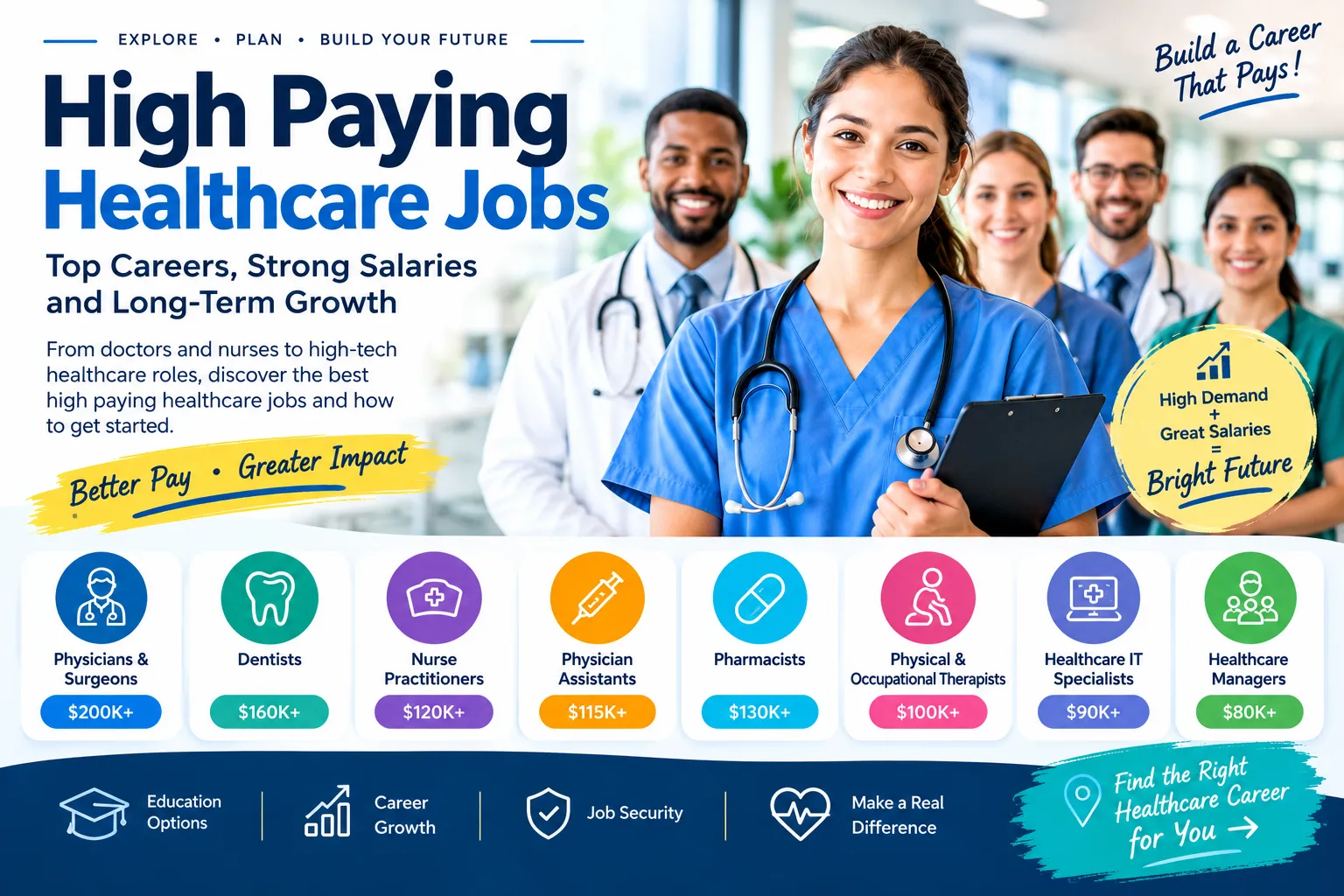
Healthcare is one of the largest career fields in the United States, and it offers opportunities at almost every level of education and experience. Some healthcare professionals earn well above the national average, while others enter the industry through shorter training programs and build their income as they gain experience.
If you are searching for high paying healthcare jobs, the first thing to understand is that there is no single “best” career for everyone. A job with a high salary may require many years of education, professional licensing, clinical training, or a significant amount of responsibility. Another healthcare career may offer a more accessible entry path but have a lower starting salary and better earning potential later.
The right choice depends on what you are willing to invest in your education, how much responsibility you want, whether you enjoy working directly with patients, and how quickly you want to enter the workforce.
According to the U.S. Bureau of Labor Statistics, healthcare occupations overall are projected to grow much faster than the average for all occupations from 2025 to 2035, with about 1.9 million openings projected each year on average. The median annual wage for healthcare practitioners and technical occupations was $86,530 in May 2025, compared with $50,980 for all occupations.
That combination of demand and earning potential makes healthcare worth exploring if you are planning a long-term career.
This guide looks at some of the high paying healthcare jobs available in the U.S., the education they typically require, what these professionals do, how much they can earn, and which options may be suitable for different career goals.
What Are High Paying Healthcare Jobs?
High paying healthcare jobs are positions in the healthcare industry that offer salaries significantly above the typical wage for many other occupations.
These careers can include High Paying Healthcare Jobs:
- Physicians and surgeons
- Dentists
- Nurse anesthetists
- Nurse practitioners
- Physician assistants
- Pharmacists
- Podiatrists
- Physical therapists
- Occupational therapists
- Advanced nursing roles
- Specialized healthcare professionals
- Certain healthcare technology and management positions
Some of the highest-paid healthcare occupations require doctoral or professional degrees, while others require a master’s degree, bachelor’s degree, associate degree, or specialized certification.
It is important to look beyond salary alone.
A career paying $200,000 may require many years of education and training, while another career paying $100,000 may offer a shorter path into the workforce.
The best career is the one that balances income with education, time, lifestyle, job demand, personal interests, and long-term opportunities.
Why Healthcare Careers Can Pay Well
There are several reasons certain healthcare careers offer strong salaries.
Specialized knowledge
Healthcare professionals often need specialized knowledge that takes years to develop.
A surgeon, anesthesiologist, dentist, nurse practitioner, or physician assistant may need extensive education and clinical training before practicing independently or within their scope of practice.
Professional licensing
Many healthcare occupations are regulated.
Licensing helps ensure that professionals meet education, examination, training, and competency requirements before providing certain services.
High level of responsibility
Healthcare workers can make decisions that directly affect patients.
The level of responsibility associated with diagnosis, treatment, medication, surgery, anesthesia, and other services can contribute to higher compensation.
Strong demand
Healthcare services are needed continuously.
The aging population, ongoing medical needs, technological developments, and the need to replace workers leaving the workforce all contribute to demand for healthcare professionals.
Specialized work environments
Some healthcare professionals work in hospitals, operating rooms, emergency departments, specialty clinics, laboratories, outpatient centers, or other environments where specialized skills are required.
1. Physicians and Surgeons
Physicians and surgeons are among the highest-paid professionals in the healthcare industry.
Physicians diagnose illnesses, develop treatment plans, monitor patients, and provide medical care. Surgeons perform procedures to treat injuries, diseases, and other medical conditions.
This is also one of the longest educational paths in healthcare.
A person pursuing medicine generally needs undergraduate education, medical school, residency training, and potentially additional fellowship training for a specialty.
According to the U.S. Bureau of Labor Statistics, physicians and surgeons had a median annual wage of $275,930 in May 2025. The BLS also reports that the highest-paid medical specialties can have substantially higher median wages.
Some specialties listed among the high paying Healthcare Jobs occupations include:
- Pediatric surgeons
- Cardiologists
- Radiologists
- Surgeons
- Anesthesiologists
- Orthopedic surgeons
- Emergency medicine physicians
- Dermatologists
The BLS reported 2025 median pay of $559,030 for pediatric surgeons, $496,010 for cardiologists, and $420,860 for radiologists.
These figures show why physician specialties are often included when people search for the highest paying healthcare careers.
However, salary should not be the only consideration.
Medical education can take many years, and physicians often work demanding schedules. Some specialties also involve long shifts, emergency calls, high-pressure decisions, and significant responsibility in High Paying Healthcare Jobs.
For someone who genuinely wants to practice medicine, however, becoming a physician can provide one of the strongest long-term earning opportunities in healthcare.
2. Dentist
Dentistry is another healthcare career with strong earning potential.
Dentists examine patients, diagnose oral health conditions, treat dental problems, perform procedures, and help patients maintain good oral health.
Some dentists work in general practice, while others specialize.
Possible areas include:
- Orthodontics
- Oral and maxillofacial surgery
- Pediatric dentistry
- Prosthodontics
- Periodontics
- Endodontics
The BLS reported a 2025 median annual wage of $172,790 for dentists overall in its occupational wage data, while several dental specialties had substantially higher median wages.
Dentistry also offers a different working environment from many hospital-based careers.
Many dentists work in dental offices rather than hospitals, and some eventually operate or own their own practices.
However, becoming a dentist requires professional education, clinical training, and licensing.
For someone interested in healthcare but particularly interested in oral health, dentistry can be a strong career option.
3. Nurse Anesthetist
Nurse anesthetists are among the highest-paid non-physician healthcare professionals.
They provide anesthesia-related care before, during, and after medical procedures. Their work requires advanced nursing education, clinical preparation, and specialized expertise.
The BLS reported a 2025 median annual wage of $223,210 for nurse anesthetists as part of the nurse anesthetists, nurse midwives, and nurse practitioners occupational group, and its wage data identifies nurse anesthetists as one of the highest-paying healthcare occupations.
This career can be particularly attractive to experienced nurses who want to advance into a highly specialized practice area.
However, it is not an entry-level healthcare job.
Becoming a nurse anesthetist requires substantial education and clinical preparation, and requirements can vary by state and program.
The job can also involve significant responsibility because anesthesia care requires careful monitoring and clinical decision-making.
4. Nurse Practitioner
Nurse practitioners are advanced practice registered nurses who can provide a wide range of healthcare services depending on their specialty, state laws, and practice setting.
They may:
- Examine patients
- Diagnose certain conditions
- Develop treatment plans
- Prescribe medications where authorized
- Order or interpret certain tests
- Provide preventive care
- Manage chronic conditions
- Educate patients
Nurse practitioners can work in primary care, family medicine, mental health, women’s health, pediatrics, and other specialties.
The career can appeal to people who want advanced clinical responsibility without following the physician pathway.
The education required is significant, but the path can be shorter than becoming a physician.
Nurse practitioner salaries vary according to specialty, location, experience, and employer.
Because advanced practice nursing continues to play an important role in healthcare delivery, it is frequently considered when people research high paying healthcare careers.
5. Physician Assistant
Physician assistants, also called PAs, examine patients, diagnose and treat illnesses, assist with procedures, prescribe medications where authorized, and work as part of healthcare teams.
Their exact responsibilities depend on state law, specialty, employer, and practice setting.
PAs can work in:
- Family medicine
- Emergency medicine
- Surgery
- Orthopedics
- Dermatology
- Internal medicine
- Urgent care
- Specialty clinics
The BLS reported a median annual wage of $135,880 for physician assistants in May 2025. The highest 10 percent earned more than $190,280.
This makes physician assistant one of the strongest high-paying healthcare careers for someone interested in advanced patient care without becoming a physician.
The typical educational requirement is a master’s degree.
A PA career can also offer flexibility because PAs may work across multiple specialties during their careers only in Medical education can take many years, and physicians often work demanding schedules. Some specialties also involve long shifts, emergency calls, high-pressure decisions, and significant responsibility in High Paying Healthcare Jobs.
6. Pharmacist
Pharmacists are healthcare professionals who specialize in medications.
Their responsibilities can include:
- Dispensing medications
- Checking prescriptions
- Educating patients
- Reviewing medication interactions
- Advising healthcare teams
- Monitoring medication therapy
- Providing certain health services where permitted
Pharmacists can work in:
- Retail pharmacies
- Hospitals
- Clinics
- Pharmaceutical companies
- Research organizations
- Government agencies
- Healthcare systems
BLS wage data shows pharmacists had a 2025 median annual wage of approximately $137,480.
Pharmacy requires professional education and licensing, so it is not a quick-entry career.
However, for people interested in medicine, chemistry, patient care, and medication management, pharmacy can be a strong long-term healthcare option.
7. Podiatrist
Podiatrists specialize in the health of the feet, ankles, and lower legs.
They diagnose and treat conditions involving:
- Foot injuries
- Bone and joint problems
- Skin conditions
- Diabetic foot problems
- Mobility issues
- Other lower-extremity conditions
Podiatrists can provide both medical and surgical care.
The BLS reported a 2025 median annual wage of $160,300 for podiatrists.
The career requires professional education and clinical training.
Although podiatry is a specialized field, it can be attractive to someone who wants a physician-level healthcare career with a focused area of practice.
8. Physical Therapist
Physical therapists help people improve movement, recover from injuries, reduce pain, and regain physical function.
They may work with patients recovering from:
- Sports injuries
- Surgery
- Accidents
- Neurological conditions
- Mobility problems
- Chronic pain
- Other physical limitations
Physical therapists can work in:
- Hospitals
- Outpatient clinics
- Rehabilitation centers
- Nursing facilities
- Schools
- Home healthcare
- Sports settings
The BLS reported a 2025 median annual wage of $102,760 for physical therapists.
The typical entry-level education is a Doctor of Physical Therapy degree.
Physical therapy can be rewarding for people who enjoy working directly with patients and seeing progress over time.
9. Occupational Therapist
Occupational therapists help people develop, recover, or maintain the skills needed for everyday activities.
They may work with people affected by:
- Injury
- Illness
- Disability
- Developmental conditions
- Aging
- Neurological disorders
Occupational therapists can work in hospitals, schools, outpatient clinics, nursing facilities, and other settings.
BLS wage data places the 2025 median annual wage for occupational therapists at about $98,340.
This can be a good career for someone who enjoys patient interaction, rehabilitation, problem-solving, and helping people become more independent.
10. Registered Nurse
Registered nursing is one of the largest healthcare professions and offers multiple paths for career development.
Registered nurses provide patient care, monitor conditions, administer treatments and medications, educate patients, and coordinate with other healthcare professionals.
RNs work in:
- Hospitals
- Clinics
- Emergency departments
- Nursing facilities
- Schools
- Home healthcare
- Government organizations
- Outpatient centers
The BLS reported a median annual wage of $97,550 for registered nurses in May 2025. The highest 10 percent earned more than $137,470.
Nursing can also provide a pathway toward higher-paying advanced roles.
For example, an experienced registered nurse may later pursue advanced education and specialize in an area such as nurse anesthesia or nurse practitioner practice Healthcare Jobs.
This makes nursing attractive not only as a job but also as a long-term career pathway.
11. Radiation Therapist
Radiation therapists operate equipment that delivers radiation treatments to patients with cancer and certain other serious conditions.
Their work requires technical knowledge, attention to detail, patient communication, and close coordination with oncology teams.
The typical entry-level education is an associate degree, although requirements vary by state and employer.
BLS data shows a 2025 median annual wage of about $105,310 for radiation therapists.
This career can be interesting for people who want to combine healthcare with advanced medical technology.
12. Healthcare Management
Not all high paying healthcare jobs involve direct patient care.
Healthcare organizations also need professionals who can manage:
- Staff
- Budgets
- Operations
- Compliance
- Scheduling
- Facilities
- Patient services
- Technology
- Administrative systems
Healthcare management can include positions such as:
- Healthcare administrator
- Medical practice manager
- Hospital department manager
- Healthcare operations manager
- Clinical manager
- Health services manager
The earning potential varies considerably depending on the position, employer, location, experience, and organization size.
This path may be especially suitable for people who enjoy leadership and organization more than hands-on clinical work.
A healthcare management career can also be built from a combination of healthcare experience and business or management education.
13. Healthcare IT Careers
Healthcare and technology have become increasingly connected.
Modern healthcare organizations rely on:
- Electronic health records
- Medical software
- Cybersecurity
- Data systems
- Digital patient services
- Telehealth
- Healthcare analytics
- Information systems
This creates opportunities for people with technology backgrounds.
Potential healthcare technology careers include:
- Health information technologist
- Healthcare data analyst
- Healthcare systems analyst
- Health IT specialist
- Healthcare cybersecurity professional
- Clinical systems specialist
- Healthcare software professional
These jobs may not involve direct patient care, but they can still be an important part of the healthcare industry.
For someone who enjoys computers and wants to enter healthcare, healthcare IT can be a particularly interesting option.
14. Health Information Careers
Health information professionals work with healthcare data and patient records.
Their responsibilities may involve:
- Electronic health records
- Medical coding
- Data quality
- Health information management
- Privacy
- Documentation
- Healthcare databases
The BLS reports that health information technologists and medical registrars had a 2025 median annual wage of around $67,310 and are projected to experience faster-than-average employment growth over the 2025–2035 period.
This career area can be a good fit for people who prefer working with information and technology rather than providing direct clinical care.
15. Occupational Health and Safety Specialist
Occupational health and safety specialists help organizations identify hazards, improve workplace safety, and comply with safety regulations.
Their work can involve:
- Workplace inspections
- Safety programs
- Risk assessment
- Training
- Accident investigation
- Compliance
- Employee health and safety
The BLS reported a 2025 median annual wage of $90,150 for occupational health and safety specialists and projected 18% employment growth from 2025 to 2035.
Although these professionals work across several industries, the occupation can be relevant to people interested in health, safety, compliance, and prevention.
Which High Paying Healthcare Jobs Require the Most Education?
There is a clear relationship between education and many of the highest-paying healthcare careers.
Professional or doctoral education
Examples include:
- Physicians
- Surgeons
- Dentists
- Podiatrists
- Physical therapists
Master’s-level education
Examples include:
- Physician assistants
- Nurse practitioners
- Some advanced healthcare roles
Bachelor’s or specialized education
Examples may include:
- Registered nurses
- Certain healthcare management positions
- Some health information and technology careers
Associate degree or specialized training
Examples may include:
- Radiation therapists
- Certain therapy assistants
- Some healthcare technician roles
This does not mean that a longer degree automatically guarantees a high salary.
Salary depends on occupation, location, experience, specialty, employer, demand, and other factors.
What Are the High Paying Healthcare Jobs Without Medical School?
If by “medical school” you mean becoming a physician, several healthcare careers can provide strong earning potential without following the physician pathway.
Examples include:
- Nurse anesthetist
- Nurse practitioner
- Physician assistant
- Dentist
- Pharmacist
- Physical therapist
- Occupational therapist
- Registered nurse
- Radiation therapist
- Certain healthcare management roles
- Certain healthcare technology roles
However, many of these careers still require significant professional education.
So it is important to distinguish between:
No medical school
and
No advanced education.
They are not the same thing.
What Are the Best High Paying Healthcare Jobs With a Shorter Education Path?
People often want a healthcare career that does not require a decade of education.
Some options with shorter educational pathways can include:
- Radiation therapist
- Certain healthcare technician roles
- Registered nursing
- Occupational therapy assistant
- Physical therapist assistant
- Medical imaging careers
- Certain health information positions
The education required varies by occupation and state.
A shorter education path may also mean a lower maximum salary compared with highly specialized professional careers.
The best approach is to compare three things:
Education time + earning potential + job demand.
Do not choose a career based on salary alone.
Are High Paying Healthcare Jobs Available Without a Four-Year Degree?
Yes, some healthcare careers can be entered without a traditional bachelor’s degree.
However, high-paying healthcare careers without a four-year degree are generally more limited than the full range of healthcare occupations.
Some roles may require an associate degree, specialized certificate, professional certification, or state licensing.
For example, radiation therapists typically enter with an associate degree, while certain therapy assistant and technical occupations can also be entered through shorter educational pathways.
The important thing is to check the exact occupation rather than assuming that “healthcare” has one universal education requirement.
What Factors Affect Healthcare Salaries?
Two people working in the same occupation can earn very different amounts.
Several factors can affect salary.
Location
Healthcare salaries can vary significantly between states and metropolitan areas.
Experience
Professionals generally gain more responsibility and may become more competitive for higher-paying positions as they gain experience.
Specialty
Specialized clinical roles can have very different compensation from general positions.
Employer
Hospitals, private practices, government organizations, outpatient centers, universities, and other employers may offer different compensation packages.
Shift
Some employers provide additional compensation for nights, weekends, holidays, or difficult schedules.
Education
Advanced education may qualify a professional for positions with greater responsibilities.
Certification
Certain certifications can improve eligibility for specialized roles, although certification does not automatically guarantee a higher salary.
High Paying Healthcare Jobs With Good Work-Life Balance
Salary is important, but lifestyle matters too.
Some healthcare careers involve long shifts, emergency calls, weekend work, or high-pressure environments.
Others may provide more predictable schedules.
When comparing careers, consider:
- Average working hours
- Night shifts
- Weekend requirements
- On-call responsibilities
- Physical demands
- Emotional stress
- Patient contact
- Administrative workload
- Remote or hybrid possibilities
For example, someone may prefer healthcare IT or health information work because it can involve less direct patient care.
Another person may prefer nursing or physical therapy because they enjoy working directly with patients.
There is no universal definition of a “good” healthcare career.
High Paying Healthcare Jobs That Are Not Doctors
If you do not want to become a physician, you still have many healthcare career options.
Some of the strongest alternatives include:
- Nurse anesthetist
- Nurse practitioner
- Physician assistant
- Dentist
- Pharmacist
- Podiatrist
- Physical therapist
- Occupational therapist
- Registered nurse
- Healthcare manager
- Specialized healthcare technologist
- Healthcare technology professional
The right option depends on how much education you are willing to complete and what type of work you want to perform.
How to Choose the Right High Paying Healthcare JObs Career
Start by asking yourself a few honest questions.
Do I enjoy working with patients?
If yes, clinical careers may be a good fit.
Do I prefer technology?
Healthcare IT, health information, data, and systems careers may be worth exploring.
Am I comfortable with a long education path?
If yes, physician, dentist, advanced nursing, and other professional careers become possible.
Do I want to start earning sooner?
Consider careers that require shorter education or training pathways.
Do I want predictable working hours?
Look closely at the schedule before choosing a profession.
Do I enjoy leadership?
Healthcare management may be a better fit than direct clinical work.
Do I enjoy science and medicine?
Clinical and technical healthcare careers may suit you.
Do I want remote work?
Some administrative, information, technology, coding, and data-related healthcare positions may offer remote or hybrid opportunities.
How to Get Started in a High Paying Healthcare jobs Career
You do not need to make the entire career decision in one day.
Start with research.
Step 1: Choose a healthcare area
Decide whether you are more interested in:
- Patient care
- Nursing
- Medicine
- Dentistry
- Pharmacy
- Rehabilitation
- Healthcare administration
- Technology
- Health information
- Medical imaging
Step 2: Check education requirements
Look at the actual requirements for the occupation.
Do not rely only on social media posts or salary videos.
Step 3: Check licensing requirements
Some healthcare professions require state licenses.
Make sure you understand the rules where you intend to work.
Step 4: Compare salary information
Use reliable sources such as the U.S. Bureau of Labor Statistics to compare occupations.
Step 5: Check employment outlook
A high salary is less useful if opportunities are extremely limited in your preferred location.
Step 6: Research real job postings
Look at actual employers and see what qualifications they request.
Step 7: Consider your long-term plan
Think about where you want to be five or ten years from now.
How to Make Your Healthcare Career More Valuable
Your earning potential can sometimes improve as your skills and responsibilities increase.
Ways to strengthen your career can include:
- Gaining relevant experience
- Completing additional education
- Earning appropriate certifications
- Developing leadership skills
- Learning healthcare technology
- Building communication skills
- Specializing in a growing area
- Developing professional connections
- Staying current with industry changes
Do not collect certifications simply because someone says they increase salary.
Choose education and certifications that are actually relevant to the occupation you want.
High Paying Healthcare Jobs and Job Security
Healthcare can offer strong employment opportunities, but no occupation is completely guaranteed.
The BLS projects healthcare occupations overall to grow much faster than average from 2025 to 2035, with about 1.9 million openings per year across the group. Many openings are expected because of both employment growth and the need to replace workers who leave their occupations.
That does not mean every healthcare job will grow at the same rate.
For example, some occupations may grow very quickly while others grow slowly.
Therefore, when evaluating a career, look at both:
Current earning potential
and
Future employment outlook.
A balanced decision is usually better than choosing a job based on salary alone.
Common Mistakes When Choosing a High Paying Healthcare Job
Choosing salary over interest
If you dislike the actual work, a high salary may not make the career satisfying.
Ignoring education costs
Some high-paying professions require significant education and training.
Consider the full investment.
Ignoring lifestyle
A high salary may come with long hours, stress, or unpredictable schedules.
Believing online salary claims
Always check authoritative wage information.
Assuming all locations pay the same
Healthcare salaries vary by location.
Ignoring licensing
Many clinical careers require state-specific licensing.
Expecting a high starting salary
Some careers have excellent long-term earning potential but modest salaries during training or early employment.
Frequently Asked Questions About High Paying Healthcare Jobs
What are the highest paying healthcare jobs?
Some of the highest-paying healthcare occupations include physicians and surgeons, dentists, nurse anesthetists, podiatrists, physician assistants, pharmacists, nurse practitioners, and certain specialized healthcare professionals. Exact pay varies by specialty, location, experience, and employer.
What healthcare job pays the most?
Physician and surgeon specialties are among the highest-paying healthcare occupations. BLS data for 2025 lists pediatric surgeons, cardiologists, radiologists, surgeons, and anesthesiologists among the highest-paid occupations in the country.
What is the high paying healthcare job without becoming a doctor?
There are several strong options, including nurse anesthetists, nurse practitioners, physician assistants, dentists, pharmacists, and other advanced healthcare professionals. Education requirements vary significantly.
What healthcare jobs pay over $100,000 a year?
Depending on occupation and location, careers such as physicians, dentists, nurse anesthetists, nurse practitioners, physician assistants, pharmacists, podiatrists, physical therapists, and certain other specialized healthcare professionals can have median or average compensation above $100,000.
Can I get a high paying healthcare job without a bachelor’s degree?
Yes, some healthcare occupations can be entered with an associate degree or specialized training. However, the highest-paying healthcare careers often require advanced professional education.
What is the best healthcare career for someone who likes technology?
Healthcare IT, health information, healthcare data, cybersecurity, clinical systems, and health technology roles can be good choices for people who enjoy technology.
What healthcare jobs have the best career growth?
Growth varies by occupation. The BLS projects faster-than-average growth for many healthcare occupations, but the exact outlook depends on the profession. Always check current occupational projections before choosing a career.
Are high paying healthcare jobs stressful?
Some can be. Physicians, surgeons, nurses, anesthetists, emergency professionals, and other clinical workers may deal with demanding schedules and high-pressure situations. Non-clinical healthcare technology or administrative roles may have different types of stress.
Can nurses move into high paying healthcare jobs ?
Yes. Registered nurses can pursue additional education and specialized training for advanced roles, depending on their goals and licensing requirements. Advanced nursing careers can offer significantly higher earning potential.
Do healthcare jobs come with benefits?
Many healthcare employers offer benefits such as health insurance, retirement plans, paid time off, and education assistance, but benefits vary by employer and position. Always review the actual employment offer.
Are high paying healthcare jobs available remotely?
Some healthcare-related jobs can be remote or hybrid, particularly in areas such as health information, healthcare technology, data, coding, administration, customer support, and certain telehealth services. Most hands-on clinical roles require workers to be physically present.
What healthcare job can I start quickly?
The fastest healthcare career depends on your location, education, and the occupation you choose. Some support and technical roles require shorter training than advanced clinical professions. Check state requirements before choosing a program.
Is healthcare a good career in the United States?
Healthcare can be a strong career field because the industry includes many occupations with different education requirements and because overall healthcare employment is projected to grow faster than average. However, the best occupation depends on your individual goals, skills, location, and willingness to complete the required education.
Final Thoughts
There is no single answer to the question of which healthcare career is best.
If your main priority is maximum earning potential, physician and specialized medical careers can be among the strongest options. If you want a high-paying career without becoming a physician, advanced nursing, physician assistant, dentistry, pharmacy, physical therapy, and other professional healthcare paths are worth exploring.
If you want to enter healthcare sooner, look at technical, support, information, and other healthcare occupations that have shorter education requirements.
The most important thing is to look at the complete picture.
Compare salary, education, licensing, job outlook, location, schedule, responsibilities, and career growth before making a decision.
Healthcare is also much broader than hospitals and doctors. Technology, health information, administration, rehabilitation, pharmacy, diagnostics, home healthcare, and other areas all contribute to the modern healthcare system.
That variety is one of the biggest advantages of choosing healthcare as a career field.
If you are serious about finding high paying healthcare jobs, start by choosing the type of work that genuinely interests you, then use reliable career information to determine the education and training needed to reach it.
A strong salary is valuable, but a career that fits your skills, interests, lifestyle, and long-term goals is much more likely to remain rewarding.
Key Takeaways
- Healthcare includes both clinical and non-clinical career paths.
- Physicians and surgeons are among the highest-paid healthcare professionals.
- Advanced nursing and physician assistant careers can also offer strong earning potential.
- Dentistry and pharmacy are other professional healthcare options with high earning potential.
- Some healthcare careers require many years of education, while others have shorter pathways.
- Salary varies by location, specialty, experience, employer, and education.
- Job outlook should be considered alongside salary.
- Healthcare IT and health information can be good choices for people interested in technology.
- Do not choose a healthcare career based on salary alone.
- Always verify education, certification, licensing, wage, and employment information using authoritative sources.



Pingback: Entry Level Healthcare Jobs: 15 Careers to Start With