

Renting a home or apartment gives you flexibility without the long-term commitment of owning a property. But even if you do not own the building you live in, you still have valuable belongings and financial responsibilities that deserve protection. This is where renters insurance can make a real difference.MSI RENTER INSURANCE
Many renters assume that their landlord’s insurance will protect everything inside their apartment or rental home. In most cases, that is not how it works. A landlord’s policy generally focuses on the building itself, while renters insurance is designed to help protect the renter’s personal belongings and provide liability coverage.
Whether you are renting your first apartment, sharing a house with roommates, moving into a new rental, or simply reviewing your existing policy, understanding how renters insurance works can help you make a more informed decision.
The good news is that renters insurance is usually straightforward. You choose coverage limits, select a deductible, pay a premium, and receive protection according to the terms, conditions, exclusions, and limits of your policy.
This complete guide explains what renters insurance covers, what it does not cover, how much it may cost, why it can be valuable, how deductibles work, what affects your premium, and what you should consider before choosing a policy.Readmore
What Is Renters Insurance?
Renters insurance is an insurance policy designed for people who rent a home, apartment, condominium, townhouse, or other residential property.
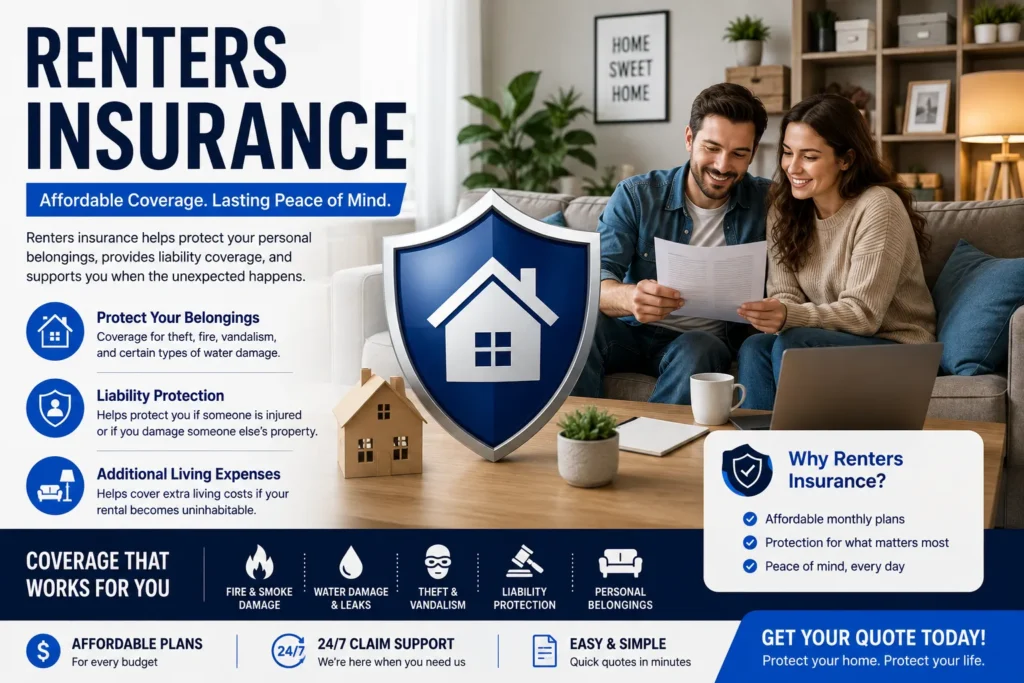
Instead of primarily insuring the physical building, renters insurance generally focuses on the renter’s personal property, personal liability, and certain additional living expenses when covered circumstances make the rental temporarily uninhabitable.
For example, imagine a fire damages your apartment and destroys some of your furniture, clothing, electronics, and other personal belongings. Your landlord may have insurance for damage to the building, but that does not necessarily mean your personal possessions are covered.
A renters insurance policy may help pay for covered losses to your belongings, subject to your policy’s deductible, coverage limits, exclusions, and other conditions.
Depending on the policy, renters insurance may also provide liability protection. If you accidentally cause property damage to someone else’s property or a visitor is injured in your rental and you are legally responsible, liability coverage may help with covered costs.
In simple terms, renters insurance can provide three major types of protection:
- Personal property coverage
- Personal liability coverage
- Additional living expense coverage
The exact protection depends on the policy you purchase.
Why Is Renters Insurance Important?
Renting can sometimes feel low-risk because the property belongs to someone else. However, your belongings inside that property can still represent thousands of dollars in value.
Think about everything you own:
- Smartphone
- Laptop
- Television
- Furniture
- Clothing
- Kitchen appliances
- Jewelry
- Shoes
- Gaming equipment
- Books
- Bicycles
- Cameras
- Home office equipment
- Personal electronics
Replacing all of these items after a major loss could be financially difficult.
For many renters, the biggest benefit of renters insurance is not simply protecting individual items. It is reducing the financial impact of an unexpected event.
A policy can also provide liability protection, which is something renters sometimes overlook.
For example, if a guest is injured in your rental and you are found legally responsible, the resulting expenses could be substantial. Liability coverage may provide protection according to your policy terms.
Some landlords also require tenants to maintain renters insurance as part of the lease agreement.
Even when it is not required, having appropriate coverage can be a practical way to protect your finances.Read About Lower Car Insurance
What Does Renters Insurance Cover?
One of the most important things to understand before buying renters insurance is what the policy actually covers.
Coverage varies by insurer and policy. Therefore, you should always read the policy documents and understand the specific exclusions and limits.
Generally, renters insurance may include the following types of protection.
1. Personal Property Coverage
Personal property coverage is designed to protect your belongings against covered causes of loss.
Depending on your policy, covered events may include certain situations such as:
- Fire
- Smoke damage
- Theft
- Vandalism
- Certain types of water damage
- Windstorm
- Lightning
- Certain accidental damage events
- Other covered perils listed in the policy
For example, suppose a covered fire damages your apartment and destroys your television, clothes, sofa, and laptop.
If those items are covered under your policy, personal property coverage may help pay for the covered loss after applying the applicable deductible and policy limits.
The important point is that renters insurance does not automatically cover every possible type of damage.
The policy wording matters.lower car insrance
2. Personal Liability Coverage
Liability coverage is another important part of renters insurance.
Suppose a visitor comes to your apartment, slips on something inside your rental, and suffers an injury. If you are legally responsible, your renters insurance liability coverage may help with certain covered expenses.
Liability coverage may also apply in certain situations involving accidental damage to someone else’s property.
For example, imagine you accidentally cause water damage to another apartment. Depending on the circumstances and policy terms, your liability coverage could potentially help with covered damages for which you are legally responsible.
Liability insurance can also provide legal defense in certain covered claims.
Because liability claims can become expensive, this coverage can be valuable even if you do not own many expensive belongings.
3. Additional Living Expenses
Imagine your rental apartment becomes temporarily uninhabitable because of a covered event.
Where would you stay?
You might need to pay for:
- Temporary accommodation
- Additional food expenses
- Transportation
- Other necessary living costs
Some renters insurance policies include additional living expenses, sometimes called loss-of-use coverage.
If the policy applies, it may help cover certain additional costs when a covered loss makes your rental home temporarily uninhabitable.
The exact limits and qualifying expenses depend on the policy.
This type of coverage can provide valuable financial support during an already stressful situation.
4. Coverage Away From Your Rental
Another useful feature of some renters insurance policies is coverage that can extend to personal belongings away from your rental property.
For example, if your laptop is stolen while you are traveling, your policy may provide coverage depending on the circumstances and policy terms.
However, special limits may apply to certain categories of property.
Items such as jewelry, collectibles, expensive electronics, firearms, business property, or other high-value belongings may have specific limits or exclusions.
If you own expensive items, ask your insurance company whether additional coverage is available.
What Does Renters Insurance Not Cover?
Understanding exclusions is just as important as understanding coverage.
Renters insurance generally does not cover everything that can happen to you or your property.
Common exclusions or limitations may involve:
- Flood damage
- Earthquake damage
- Certain types of water damage
- Normal wear and tear
- Maintenance problems
- Intentional damage
- Certain high-value items beyond policy limits
- Certain business-related property or losses
- Damage caused by certain excluded events
The exact exclusions depend on the policy.
For example, standard renters insurance generally does not provide the same type of flood coverage that a dedicated flood insurance policy provides.
If you live in an area where flooding is a concern, it is important to investigate whether separate flood coverage may be appropriate.
The same principle applies to earthquakes and other risks that may be excluded or treated differently under a standard policy.
Never assume that a particular event is covered simply because you have renters insurance.
Check the policy.
How Much Does Renters Insurance Cost?
One of the most common questions renters ask is:
How much does renters insurance cost?
There is no single price that applies to every renter.
Your premium can depend on several factors, including:
- Location
- Coverage limits
- Deductible
- Claims history
- Type of property
- Safety features
- Credit-based insurance factors where legally permitted
- Selected optional coverage
- Insurance company
- Risk characteristics of the rental property
Because of these differences, two renters living in different locations can receive very different quotes.
The best way to determine your actual cost is to compare personalized quotes from insurers.
The important thing is not simply finding the cheapest policy.
A policy with a lower premium may also have lower coverage limits, higher deductibles, or more restrictive coverage.
Instead of asking only, “What is the cheapest renters insurance?” consider asking:
“Which policy gives me appropriate protection for a reasonable price?”
That is a much better long-term approach.
What Factors Affect Renters Insurance Cost?
Several factors can influence your premium.
Location
Where you live can significantly affect insurance pricing.
Insurance companies evaluate factors such as local weather risks, crime rates, claims patterns, and other regional characteristics.
A renter in one city may pay a different premium than someone with a similar apartment in another city.
Coverage Amount
The more personal property coverage you select, the more protection you have available for covered losses.
Higher coverage limits can result in higher premiums.
That does not mean you should automatically choose the lowest limit.
You should estimate the realistic replacement value of your belongings.
Deductible
Your deductible is the amount you generally pay toward a covered claim before insurance pays the remaining eligible amount, subject to policy terms.
For example, if you have a covered loss of $5,000 and a $500 deductible, you may be responsible for the first $500, with the insurer potentially paying the remaining covered amount up to applicable limits.
A higher deductible may reduce your premium, but it also means you would have to pay more out of pocket when filing a covered claim.
Choose a deductible you could realistically afford.
Actual Cash Value vs. Replacement Cost
When comparing renters insurance policies, pay attention to how your personal property is valued.
Two common approaches are:
Actual cash value (ACV)
and
Replacement cost value (RCV).
Actual cash value generally considers depreciation when determining the value of damaged or stolen property.
Replacement cost coverage is designed to pay the amount needed to replace covered property with similar property, subject to policy terms and limits, without applying depreciation in the same way.
Consider a five-year-old laptop.
Under an actual cash value approach, depreciation may significantly reduce the amount payable for the covered loss.
With replacement cost coverage, the calculation may be more favorable for replacing the item, subject to the policy’s rules.
Replacement cost coverage may cost more, but it can provide greater protection for many renters.
Always check how your insurer defines these terms.
How Much Renters Insurance Do You Need?
There is no universal coverage amount that works for everyone.
The right amount depends on the value of your belongings and your financial situation.
A useful starting point is to create a home inventory.
Walk through every room and make a list of what you own.
Include:
- Furniture
- Electronics
- Clothing
- Kitchen equipment
- Appliances
- Jewelry
- Computers
- Phones
- Sports equipment
- Musical instruments
- Collectibles
- Home office equipment
You do not need to make the process complicated.
You can take photos or videos of your belongings and keep receipts for expensive purchases.
Store your inventory somewhere secure, such as cloud storage.
The goal is to make it easier to estimate your belongings’ value and document what you own if you ever need to make a claim.
What Is a Renters Insurance Deductible?
A deductible is the amount you agree to pay toward a covered claim before your insurance coverage responds, subject to the policy’s terms.
For example, imagine your covered property loss is $3,000 and your deductible is $500.
If the loss is fully covered and within your policy limits, you could generally be responsible for the $500 deductible, while the insurer would consider the remaining covered amount.
Deductibles can vary.
A lower deductible usually means you pay less out of pocket when making a covered claim, but your premium may be higher.
A higher deductible can reduce your premium, but you take on more financial responsibility when a covered loss occurs.
The right choice depends on your budget and how much unexpected expense you could comfortably handle.
Does Renters Insurance Cover Theft?
Renters insurance may cover theft of personal belongings when the theft falls within a covered cause of loss.
For example, if someone breaks into your apartment and steals covered personal property, your policy may help reimburse you for the covered loss after the deductible and subject to applicable limits.
However, there can be special limits for certain valuable items.
If you own expensive jewelry, watches, collectibles, cameras, or other high-value possessions, check your policy carefully.
You may need scheduled personal property coverage or another endorsement for adequate protection.
Keeping receipts, photographs, appraisals, and other documentation can also make it easier to establish ownership and value if a claim occurs.
Does Renters Insurance Cover Water Damage?
Water damage is one of the areas where renters should pay particularly close attention to their policy.
Some types of water damage may be covered, while others may be excluded.
For example, coverage may depend on the source of the water, the cause of the damage, and the policy wording.
Damage caused by certain sudden and accidental incidents may be treated differently from gradual leaks, maintenance problems, flooding, or other excluded causes.
If you live in an apartment, it is especially important to understand how your policy interacts with damage caused by plumbing problems or neighboring units.
When in doubt, ask your insurer for a clear explanation before a problem occurs.
Does Renters Insurance Cover Fire Damage?
Fire is commonly among the risks addressed by renters insurance policies, subject to the policy terms and exclusions.
If a covered fire damages your personal belongings, personal property coverage may help pay for eligible losses.
Depending on the circumstances, additional living expense coverage may also help with qualifying temporary living costs if your rental becomes uninhabitable due to a covered loss.
However, coverage limits and deductibles still apply.
This is another reason why having accurate coverage limits is important.
Does Renters Insurance Cover a Roommate?
This is a common source of confusion.
Generally, you should not assume that your roommate’s belongings are automatically covered by your renters insurance policy.
Coverage for roommates depends on the policy and the relationship between the people living in the rental.
Some insurers may allow certain household members to be included, while others may require separate policies.
The safest approach is to ask the insurance company directly.
If you have a roommate, clarify:
- Who is named on the policy?
- Whose belongings are covered?
- What are the coverage limits?
- How would a claim involving shared property work?
- Does each roommate need a separate policy?
Never assume everyone in a shared rental is automatically insured.
Is Renters Insurance Required?
Renters insurance is not universally required by law for every renter.
However, a landlord may require tenants to carry renters insurance as a condition of the lease.
If your lease requires it, you should maintain the required coverage for as long as you live in the property.
Even if your landlord does not require it, renters insurance can still be worthwhile.
The cost of replacing your belongings after a major loss can be much greater than the cost of maintaining an insurance policy.
Always review your lease to see whether your landlord has specific insurance requirements.
Renters Insurance vs. Landlord Insurance
These two types of insurance serve different purposes.
Landlord insurance generally protects the property owner’s building and may include liability coverage related to the landlord’s ownership of the property.
Renters insurance is designed to protect the renter’s personal belongings and personal liability, along with other coverage such as additional living expenses when included and applicable.
Imagine a fire damages an apartment.
The landlord’s insurance may address damage to the building.
Your renters insurance may address your covered personal belongings.
That distinction is extremely important.
A landlord’s insurance policy generally should not be viewed as a replacement for renters insurance.
How to Choose the Best Renters Insurance
Choosing a renters insurance policy does not have to be complicated.
Start with these steps.
Step 1: Calculate Your Belongings
Create a simple inventory of everything you own.
Estimate replacement costs rather than guessing based on a few expensive items.
Step 2: Determine Your Liability Needs
Consider your financial situation and the risks associated with your rental.
Compare the liability limits available from different insurers.
Step 3: Compare Deductibles
Look at both the premium and deductible.
Do not select a deductible that would be difficult for you to pay after an unexpected loss.
Step 4: Check Coverage Types
Compare whether policies offer:
- Personal property coverage
- Liability coverage
- Additional living expenses
- Replacement cost options
- Optional endorsements
- Special coverage for valuable items
Step 5: Read the Exclusions
This step is often skipped.
Do not only read what the policy covers.
Understand what it does not cover.
Step 6: Compare Multiple Quotes
Insurance prices can vary significantly between companies.
Get multiple quotes and compare the actual coverage rather than looking only at the monthly premium.
How to Save Money on Renters Insurance
You do not necessarily need to sacrifice useful coverage to reduce your insurance cost.
Here are several practical strategies.
Bundle Policies
If you have auto insurance, ask whether the insurer offers a discount for bundling renters and auto insurance.
Increase Your Deductible Carefully
A higher deductible may reduce your premium.
However, only choose a deductible you can comfortably afford.
Improve Security
Security devices such as smoke detectors, alarms, deadbolts, and certain monitoring systems may qualify for discounts with some insurers.
Ask your provider what discounts are available.
Compare Quotes
Shopping around is one of the simplest ways to potentially find a better price.
Do not assume your current insurer is automatically the cheapest or best option.
Review Your Policy Regularly
Your insurance needs can change.
If you buy expensive electronics, jewelry, furniture, or other valuable belongings, your existing limits may no longer be enough.
Review your policy periodically.
What Should You Do Before Buying Renters Insurance?
Before purchasing a policy, prepare a few basic details.
You may need:
- Rental address
- Estimated value of belongings
- Desired coverage limits
- Desired deductible
- Information about security systems
- Previous insurance information
- Claims history
- Information about additional household members
Having this information ready can make the quote process easier.
It is also useful to compare policies side by side rather than relying on memory.
What Should You Do If You Need to File a Claim?
If you experience a covered loss, contact your insurance company as soon as reasonably possible.
The exact claims process varies, but common steps include:
- Make sure everyone is safe.
- Prevent additional damage when it is reasonably safe to do so.
- Contact the appropriate emergency services if necessary.
- Document the damage with photographs or videos.
- Keep damaged property when safe unless instructed otherwise.
- Notify your insurance company.
- Provide requested documents.
- Keep receipts for eligible temporary expenses.
- Cooperate with the claims investigation.
- Keep records of communications and claim information.
Do not exaggerate a claim.
Provide accurate information and documentation.
A detailed home inventory can be extremely helpful during this process.
Common Renters Insurance Mistakes to Avoid
Many renters make avoidable mistakes when purchasing insurance.
Choosing Coverage Based Only on Price
The cheapest policy is not necessarily the best value.
Compare coverage, limits, deductibles, exclusions, and customer service considerations.
Underestimating Personal Belongings
People often underestimate how expensive it would be to replace everything they own.
Create an inventory instead of guessing.
Ignoring Valuable Items
Certain expensive items may have special limits.
Ask about additional coverage when necessary.
Assuming Flood Damage Is Covered
Standard renters insurance may not cover flood damage.
Check your policy and consider separate coverage if appropriate.
Forgetting About Liability Coverage
Your belongings are not the only thing worth protecting.
Liability coverage can be an important part of a renters policy.
Never Reviewing the Policy
Your circumstances can change.
Review your coverage after major purchases, moves, or lifestyle changes.
Is Renters Insurance Worth It?
For many renters, renters insurance can be a practical and relatively affordable way to protect against potentially large financial losses.
The value becomes particularly clear when you consider the cost of replacing everything you own.
A single unexpected event can potentially cause thousands of dollars in property damage.
Without insurance, you may have to pay for replacement costs yourself.
Renters insurance can also provide liability protection and potentially help with additional living expenses after certain covered losses.
Whether a particular policy is worth the price depends on your circumstances, coverage needs, and budget.
The best approach is to compare your potential financial risk with the cost of appropriate coverage.

Final Thoughts on Renters Insurance
Renters insurance is more than a policy for replacing furniture after a disaster.
It can provide a financial safety net for your belongings, personal liability, and temporary living expenses after certain covered events.
The right policy depends on where you live, what you own, the risks you face, and how much financial protection you want.
Before choosing a policy, take time to calculate the value of your belongings, compare coverage limits, understand the deductible, review exclusions, and request multiple quotes.
Most importantly, do not assume that your landlord’s insurance protects your personal belongings.
Your rental may be someone else’s property, but everything inside it can still represent years of purchases, memories, and financial investment.
Taking a little time to understand renters insurance today can help you make a smarter decision about protecting what matters to you tomorrow. Pins
Frequently Asked Questions About Renters Insurance
What is renters insurance?
Renters insurance is an insurance policy designed to protect a tenant’s personal belongings and provide liability protection. Depending on the policy, it may also provide coverage for additional living expenses after certain covered losses.
Is renters insurance worth it?
For many renters, renters insurance can be worthwhile because it can help protect personal belongings and provide liability coverage against covered risks. The value depends on your individual circumstances and the policy you choose.
How much does renters insurance cost?
The cost varies depending on factors such as location, coverage limits, deductible, claims history, insurer, and other risk factors. Comparing personalized quotes is the best way to determine your potential premium.
Does renters insurance cover theft?
Many renters insurance policies provide coverage for theft of covered personal property, subject to deductibles, limits, exclusions, and policy conditions.
Does renters insurance cover fire?
Fire is commonly a covered peril under renters insurance policies, but coverage depends on the specific policy. Personal belongings may be covered after a qualifying loss, subject to applicable limits and deductibles.
Does renters insurance cover water damage?
Some types of water damage may be covered, while others may be excluded. Coverage depends on the cause and source of the damage and the specific policy wording.
Does renters insurance cover flooding?
Standard renters insurance generally does not provide the same type of coverage as a dedicated flood insurance policy. If flooding is a concern, ask an insurance professional about appropriate coverage.
Does renters insurance cover roommates?
Not necessarily. Roommate coverage depends on the insurer and policy. Each roommate may need a separate renters insurance policy.
Does renters insurance cover my landlord’s property?
Renters insurance is primarily designed to protect the renter’s belongings and liability, not the landlord’s building. The landlord generally has separate insurance for the property.
Does renters insurance cover my car?
Renters insurance generally does not replace auto insurance for your vehicle. However, certain personal belongings inside your vehicle may potentially receive coverage under your renters policy depending on the circumstances and policy terms.
What is a renters insurance deductible?
A deductible is the amount you generally pay toward a covered claim before insurance pays the remaining eligible amount, subject to policy terms and limits.
Can renters insurance cover a laptop?
A laptop may be covered as personal property under a renters insurance policy, subject to the policy’s covered causes of loss, limits, deductible, and exclusions.
Can renters insurance cover jewelry?
Jewelry may be covered, but standard policies can have special limits for certain valuable items. Additional coverage may be available for high-value jewelry.
Can my landlord require renters insurance?
A landlord may require renters insurance as part of a lease agreement, depending on applicable laws and the terms of the rental agreement.
How much personal property coverage do I need?
You should choose a limit based on the estimated replacement value of your belongings. Creating a home inventory can help you calculate a realistic amount.
What is replacement cost renters insurance?
Replacement cost coverage is designed to help replace covered belongings with similar items without applying depreciation in the same manner as actual cash value coverage, subject to the policy’s conditions and limits.
What is actual cash value?
Actual cash value generally considers depreciation when determining the value of covered property after a loss.
Can renters insurance cover a temporary hotel stay?
Some renters insurance policies include additional living expense coverage that may help with qualifying temporary accommodation and other additional costs after a covered loss makes the rental uninhabitable.
Can I get renters insurance online?
Many insurance companies allow renters to obtain quotes and purchase policies online. You should still review the coverage details, exclusions, limits, and deductible before purchasing.
Can I change my renters insurance coverage?
In many cases, you can adjust your coverage by contacting your insurer. Changes may affect your premium, so review the updated policy details carefully.
What happens if I move to another apartment?
You should notify your insurance company before or after moving, depending on the insurer’s instructions. Your premium and coverage details may change based on the new address.
Does renters insurance cover damage caused by my pet?
Coverage can vary. Some policies may provide certain liability protection related to pets, while exclusions or restrictions can apply. Check your policy before assuming your pet is covered.
Does renters insurance cover business equipment?
Business property and business-related losses may have special limitations or exclusions. If you work from home or operate a business, ask your insurer whether additional coverage is needed.
How can I lower my renters insurance premium?
You may be able to reduce your premium by comparing insurers, bundling policies, choosing an appropriate deductible, qualifying for safety-related discounts, and reviewing your coverage regularly.
How often should I review my renters insurance?
Review your policy at least when major circumstances change, such as moving, purchasing expensive belongings, getting married, adding household members, or starting a home-based business.
Quick Renters Insurance Checklist
Before choosing a policy, ask yourself:
- What is the total value of my belongings?
- Do I know my desired coverage limit?
- Can I afford the deductible?
- Does the policy include liability coverage?
- Does it include additional living expense coverage?
- Is personal property covered at actual cash value or replacement cost?
- Are my valuable items adequately protected?
- Are flood or earthquake risks relevant where I live?
- Does my lease require renters insurance?
- Have I compared multiple quotes?
- Have I read the exclusions?
- Do I have a home inventory?
- Are my receipts and photos stored securely?
Answering these questions can make the process much easier.
Important Note
Insurance policies differ by company, state, coverage form, limits, exclusions, endorsements, and individual circumstances. Information in this guide is intended for general educational purposes and should not be considered insurance, legal, or financial advice. Always read your policy documents and speak with a qualified insurance professional about your specific coverage needs.
Conclusion
Choosing renters insurance is ultimately about preparing for risks before they become expensive problems.
You may never need to file a claim, and hopefully you never will. But having appropriate coverage can provide valuable financial protection if an unexpected covered event affects your belongings, your rental home, or your liability.
Start by understanding what you own, estimate how much it would cost to replace your belongings, compare coverage options, and pay close attention to deductibles and exclusions.
The goal is not simply to find the cheapest policy.
The goal is to find appropriate renters insurance coverage that fits your needs, protects what matters to you, and fits comfortably within your budget.
With the right information, comparing renters insurance can be much simpler—and you can make your decision with greater confidence.