15 Powerful SaaS Recruitment Software Benefits That Transform Modern Hiring in 2026
Introduction
Hiring top talent has become more competitive than ever, and businesses need faster, smarter, and more efficient ways to attract, manage, and hire candidates. This is where SaaS recruitment software has transformed modern hiring. Instead of relying on spreadsheets, emails, and outdated applicant tracking systems, organizations now use cloud-based recruitment platforms that streamline every stage of the hiring process.
SaaS recruitment software is a cloud-based hiring solution that helps businesses manage the entire recruitment process more efficiently.
In this comprehensive guide, you’ll learn everything about SaaS recruitment software, including how it works, its key features, benefits, challenges, implementation strategies, and the latest hiring trends. By the end of this article, you’ll understand why more businesses are adopting cloud-based recruitment platforms to build stronger teams and stay ahead in today’s talent-driven market.SaaS Companies UK
Table of Contents
- What Is SaaS Recruitment Software?
- How SaaS Recruitment Software Works
- Why Companies Choose SaaS Recruitment Software
- Essential Features of SaaS Recruitment Software
- Types of SaaS Recruitment Software
- Benefits of SaaS Recruitment Software
- SaaS Recruitment Software vs Traditional Recruitment Systems
- How to Choose the Best SaaS Recruitment Software
- Future Trends in SaaS Recruitment Software
- FAQs
What Is SaaS Recruitment Software?
SaaS recruitment software is a cloud-based hiring platform that enables organizations to manage the entire recruitment process online. Instead of installing software on local servers, companies access the platform through a secure web browser or mobile application by paying a monthly or annual subscription.
Modern SaaS recruitment software centralizes every hiring activity—from posting job openings and collecting applications to screening candidates, scheduling interviews, and sending offer letters. This allows HR teams and recruiters to work more efficiently while reducing manual administrative work.
Unlike traditional recruitment systems that often require costly maintenance and IT support, SaaS recruitment software provides automatic updates, continuous improvements, and scalable infrastructure managed by the software provider.
Simple Definition
Think of SaaS recruitment software as a complete digital hiring assistant that helps businesses find, evaluate, and hire the right candidates using one centralized cloud platform.
How SaaS Recruitment Software Works
At its core, SaaS recruitment software automates and simplifies the hiring journey by connecting recruiters, hiring managers, and job seekers through a single online platform.
A typical hiring workflow includes:
- Create a new job opening.
- Publish the vacancy across multiple job boards.
- Receive applications in one dashboard.
- Automatically screen resumes.
- Rank candidates based on qualifications.
- Schedule interviews.
- Collaborate with hiring managers.
- Send offer letters.
- Complete onboarding.
Because SaaS recruitment software stores all recruitment data securely in the cloud, authorized team members can access candidate information anytime and from any location.
Why Companies Are Choosing SaaS Recruitment Software
The hiring landscape has changed dramatically over the past decade. Companies receive hundreds or even thousands of applications for a single position, making manual recruitment inefficient and time-consuming.
SaaS recruitment software solves these challenges by improving speed, accuracy, and collaboration throughout the hiring process.
1. Faster Hiring
Recruiters often spend countless hours reviewing resumes and coordinating interviews. SaaS recruitment software automates these repetitive tasks, allowing HR teams to identify qualified candidates much faster and reduce time-to-hire.
2. Lower Recruitment Costs
Traditional recruitment systems often require expensive hardware, software licenses, and dedicated IT teams. With SaaS recruitment software, businesses pay a subscription fee while the provider manages infrastructure, updates, and maintenance.
This significantly lowers upfront costs and makes advanced recruitment technology accessible to businesses of all sizes.
3. Better Candidate Experience
Today’s job seekers expect a simple and professional application process. SaaS recruitment software enables companies to provide:
- Mobile-friendly applications
- Quick application forms
- Automated status updates
- Interview reminders
- Personalized communication
- Faster hiring decisions
A positive experience improves employer branding and increases the likelihood that top candidates will accept job offers.
4. Improved Team Collaboration
Hiring often involves HR professionals, department managers, and executives. SaaS recruitment software allows all stakeholders to review resumes, share interview feedback, rate candidates, and make hiring decisions within one centralized platform.
This eliminates lengthy email chains and ensures everyone works with the latest candidate information.
Essential Features of SaaS Recruitment Software
A modern SaaS recruitment software platform offers powerful features designed to simplify every stage of talent acquisition.
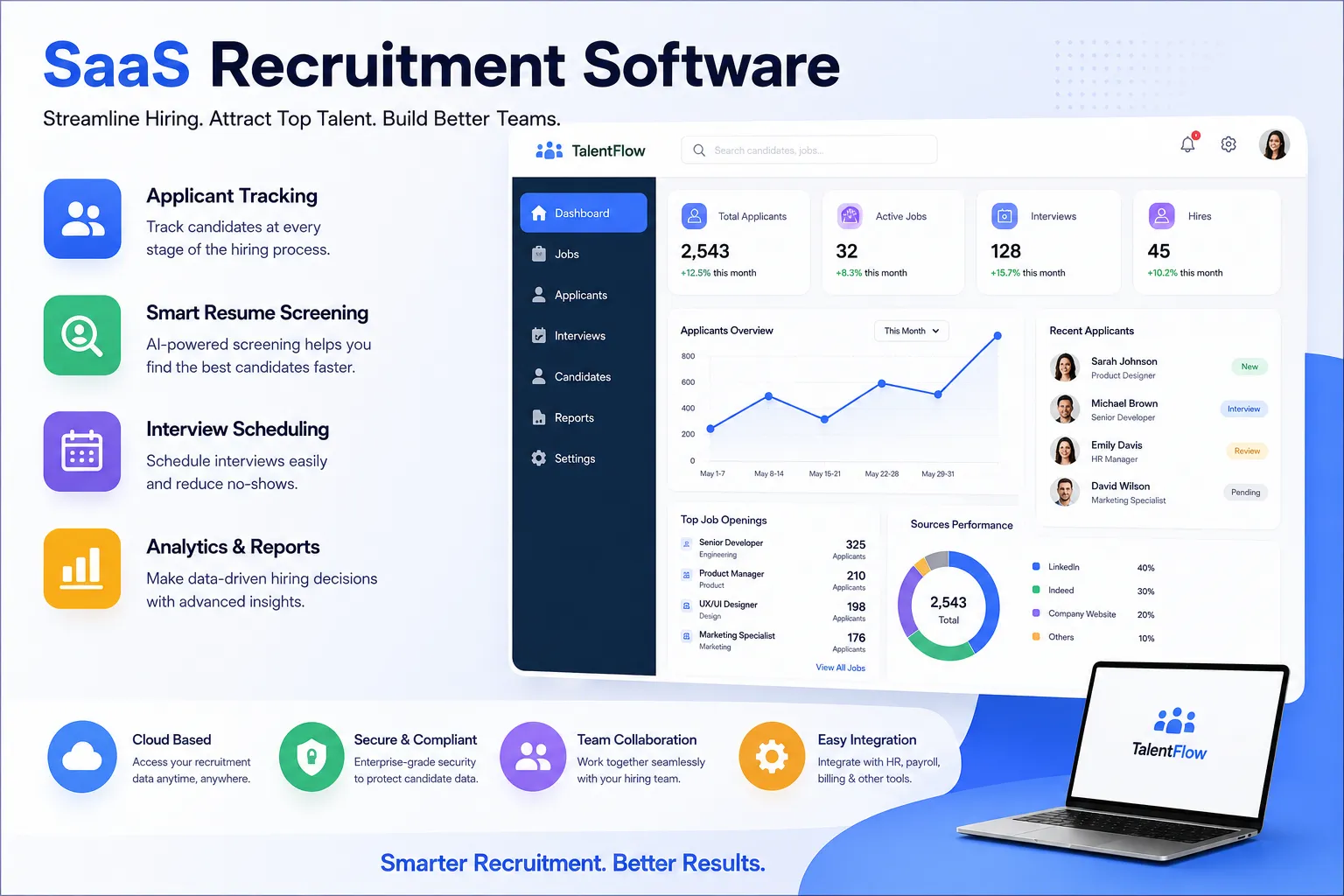
Applicant Tracking System (ATS)
One of the most valuable components of SaaS recruitment software is its built-in Applicant Tracking System (ATS).
An ATS helps recruiters:
- Store candidate profiles
- Track application status
- Search resumes quickly
- Filter applicants
- Manage hiring pipelines
- Reduce manual work
This feature keeps recruitment organized and ensures no qualified applicant is overlooked.
AI Resume Screening
Many SaaS recruitment software platforms now use artificial intelligence to automatically analyze resumes and identify candidates who best match the job requirements.
AI-powered screening can:
- Match skills
- Compare experience
- Rank applicants
- Reduce recruiter workload
- Improve hiring efficiency
While AI assists with screening, recruiters should always review shortlisted candidates to ensure fair and balanced hiring decisions.
Multi-Job Board Posting
Instead of posting vacancies individually, SaaS recruitment software allows recruiters to publish jobs simultaneously across multiple platforms.
This may include:
- Company career pages
- Professional networking sites
- General job boards
- Industry-specific job websites
This wider reach helps attract a larger and more diverse pool of qualified candidates.
Interview Scheduling
Coordinating interviews can consume valuable time. SaaS recruitment software automates interview scheduling by integrating with popular calendar applications and allowing candidates to choose available time slots.
Benefits include:
- Fewer scheduling conflicts
- Automated reminders
- Calendar synchronization
- Better communication
- Reduced administrative workload
Recruitment Analytics
Hiring decisions improve when backed by reliable data. SaaS recruitment software provides dashboards and reports that help organizations monitor important recruitment metrics, such as:
- Time-to-hire
- Cost-per-hire
- Source of hire
- Offer acceptance rate
- Candidate conversion rate
- Recruiter performance
These insights allow businesses to continuously refine their hiring strategies.
Candidate Relationship Management (CRM)
Building long-term relationships with potential employees is becoming increasingly important. Many SaaS recruitment software solutions include Candidate Relationship Management features that enable recruiters to nurture talent pools, communicate with passive candidates, and maintain engagement for future opportunities.
Types of SaaS Recruitment Software
Different organizations have different hiring needs, and SaaS recruitment software is available in several categories.
Applicant Tracking Software
Designed to manage candidate applications from submission through hiring, this type of SaaS recruitment software is ideal for organizations seeking a structured hiring workflow.
Recruitment Marketing Platforms
These platforms focus on employer branding, job advertising, and attracting high-quality candidates through digital marketing techniques.
Interview Management Software
Interview-focused SaaS recruitment software helps companies coordinate interviews, gather feedback, evaluate candidates, and streamline decision-making.
Employee Onboarding Platforms
Some SaaS recruitment software extends beyond hiring by supporting digital onboarding, document collection, compliance management, and new employee orientation.
Benefits of SaaS Recruitment Software
Organizations worldwide are investing in SaaS recruitment software because it delivers measurable improvements across the hiring process.
Faster Recruitment
Automation reduces manual work, enabling recruiters to fill vacancies more quickly without sacrificing candidate quality.
Better Hiring Decisions
With centralized candidate data, structured evaluations, and analytics, SaaS billing software helps hiring teams make more informed decisions.
Increased Productivity
By automating repetitive administrative tasks, recruiters can spend more time building relationships with candidates and focusing on strategic hiring initiatives.
Scalability
Whether hiring five employees or five hundred, SaaS recruitment software can easily scale to meet changing recruitment demands without major infrastructure investments.
Enhanced Data Security
Leading providers of SaaS recruitment software implement enterprise-grade security measures, including encryption, role-based access controls, regular backups, and compliance with global data protection standards, helping organizations safeguard sensitive candidate information.
SaaS Recruitment Software vs Traditional Recruitment Systems
As businesses continue to modernize their hiring strategies, many HR leaders are replacing legacy recruitment tools with SaaS recruitment software. Traditional systems often require expensive infrastructure, manual updates, and limited remote accessibility. In contrast, SaaS recruitment software is cloud-based, making it easier to manage hiring from anywhere while improving collaboration, security, and scalability.
| Feature | SaaS Recruitment Software | Traditional Recruitment System |
|---|---|---|
| Deployment | Cloud-based | On-premises |
| Initial Cost | Low subscription | High upfront investment |
| Maintenance | Automatic updates | Manual updates |
| Accessibility | Anywhere with internet | Usually office network |
| Scalability | Easy to scale | Requires additional hardware |
| Security Updates | Automatic | IT team responsibility |
| Integration | Excellent | Often limited |
| Remote Hiring | Fully supported | Limited |
For organizations that hire frequently, SaaS recruitment software offers greater flexibility and significantly reduces administrative work compared to traditional recruitment platforms.
Step-by-Step Guide to Implementing SaaS Recruitment Software
Choosing the right SaaS recruitment software is only the first step. A successful implementation ensures your hiring team can maximize productivity while minimizing disruption.
Step 1: Identify Your Recruitment Needs
Before selecting any SaaS recruitment software, evaluate your current recruitment process.
Ask questions like:
- How many employees do you hire each year?
- Which recruitment tasks consume the most time?
- Do you need AI-powered screening?
- Will multiple departments use the system?
- What integrations are essential?
Clearly defining your goals helps you choose software that aligns with your hiring strategy.
Step 2: Set a Realistic Budget
Every organization has different financial requirements. Most SaaS recruitment software providers offer subscription-based pricing with monthly or annual plans.
When planning your budget, consider:
- Number of recruiters
- Number of active job postings
- Storage requirements
- Premium AI features
- Integration costs
- Customer support options
Although recruitment is the primary focus, many growing businesses also invest in SaaS billing software to automate subscription payments, invoicing, and financial reporting. Integrating SaaS recruitment software with SaaS billing software helps streamline business operations by connecting hiring expenses with accounting and finance systems.
Step 3: Choose the Right Vendor
Not every platform offers the same capabilities. Compare different SaaS recruitment software providers based on:
- Ease of use
- Customer reviews
- Security standards
- Customer support
- AI capabilities
- Reporting tools
- API availability
- Compliance certifications
- Mobile accessibility
Request product demonstrations and free trials before making your final decision.
Step 4: Migrate Existing Recruitment Data
If you’re switching from another hiring platform, migrate candidate information carefully.
Most SaaS recruitment software vendors provide migration assistance for:
- Candidate profiles
- Job postings
- Interview notes
- Recruitment history
- Recruiter accounts
- Talent pools
A structured migration reduces data loss and minimizes downtime.
Step 5: Train Your Hiring Team
Even the most advanced SaaS recruitment software requires proper training.
Provide onboarding sessions covering:
- Candidate management
- Resume filtering
- Interview scheduling
- Recruitment reporting
- Collaboration tools
- AI-powered recommendations
Well-trained recruiters adopt new technology faster and achieve better hiring outcomes.
Common Challenges of SaaS Recruitment Software
Although SaaS recruitment software offers numerous benefits, organizations may encounter challenges during adoption.
Data Migration Challenges
Moving years of recruitment data into a new SaaS recruitment software platform can be time-consuming. Careful planning and vendor support help ensure a smooth transition.

User Adoption
Some employees may resist changing familiar workflows. Demonstrating the productivity benefits of SaaS recruitment software and providing adequate training encourages faster adoption.
Integration Complexity
Many companies already use HR systems, payroll platforms, CRMs, and SaaS billing software. Ensuring seamless integration between SaaS recruitment software and these business applications is essential for avoiding duplicate work and maintaining accurate data.
Security Concerns
Recruitment data includes resumes, contact details, salary expectations, and interview feedback. Organizations should choose SaaS recruitment software providers that offer:
- End-to-end encryption
- Multi-factor authentication
- Role-based permissions
- Regular backups
- Compliance with privacy regulations
- Continuous security monitoring
How to Choose the Best SaaS Recruitment Software
Selecting the right SaaS software as requires more than comparing prices. Consider both current needs and future business growth.
Ease of Use
An intuitive interface reduces training time and improves recruiter productivity. The best SaaS software as should be simple enough for HR teams while still offering advanced functionality.
AI Automation
Artificial intelligence has become a valuable feature in modern SaaS software as . Look for capabilities such as:
- Resume parsing
- Candidate matching
- Automated interview scheduling
- Skill-based ranking
- Duplicate candidate detection
These features reduce manual effort while helping recruiters focus on high-value activities.
Customization
Every organization has unique hiring processes. Flexible SaaS software as allows businesses to customize:
- Hiring pipelines
- Recruitment stages
- Approval workflows
- Email templates
- Evaluation scorecards
- Career pages
Customization ensures the platform supports your existing workflow instead of forcing major process in SaaS software as changes.
Integration Capabilities
Your recruitment platform should connect seamlessly with other business tools.
Modern SaaS software as commonly integrates with:
- HRIS platforms
- Payroll software
- CRM systems
- Calendar applications
- Video interview platforms
- Email services
- Background verification tools
- SaaS billing software for subscription management and financial reporting
Strong integrations eliminate repetitive data entry and improve operational efficiency.
Real-World Use Cases
Startup Companies
Startups often have limited HR resources.SaaS software as enables founders and hiring managers to publish jobs, review applications, schedule interviews, and collaborate without needing a large recruitment team.
Mid-Sized Businesses
Growing companies benefit from SaaS Billing software by managing higher application volumes while maintaining a consistent hiring process across multiple departments.
Enterprise Organizations
Large enterprises use SaaS software as to coordinate recruitment across different offices, countries, and business units while maintaining standardized hiring practices and compliance requirements.
Recruitment Agencies
Staffing firms rely on SaaS recruitment software to manage large talent databases, match candidates with clients, automate communications, and monitor recruiter performance efficiently.
Expert Tips for Maximizing SaaS Recruitment Software
To get the best results from SaaS recruitment software, consider these proven practices:
- Keep job descriptions clear and updated.
- Build talent pools for future hiring.
- Regularly review recruitment analytics.
- Automate repetitive tasks where appropriate.
- Maintain consistent communication with candidates.
- Collect feedback from hiring managers.
- Optimize career pages for mobile users.
- Periodically review software integrations, including SaaS billing software, HR, payroll, and CRM systems to ensure smooth workflows.
Common Mistakes to Avoid
Many organizations fail to realize the full value of SaaS recruitment software because of avoidable mistakes.
Avoid these common pitfalls:
- Choosing software based only on price.
- Ignoring employee training.
- Skipping security reviews.
- Failing to define recruitment goals.
- Neglecting software integrations.
- Not measuring recruitment performance.
- Overlooking candidate experience.
- Delaying software updates or feature adoption.
By avoiding these mistakes, businesses can maximize the return on their investment in SaaS recruitment software while keeping recruitment processes efficient and candidate-focused.
Future Trends in SaaS Billing Software
The recruitment industry is evolving rapidly, and SaaS Billing software continues to introduce innovative features that help organizations hire faster and more intelligently. Companies that embrace these advancements will be better positioned to attract top talent while improving efficiency and reducing hiring costs.
Artificial Intelligence Will Become Smarter
Artificial Intelligence (AI) is already a key feature of many SaaS billing software platforms, but its role will continue to expand.
Future AI capabilities may include:
- More accurate resume matching
- Predictive hiring analytics
- Personalized candidate recommendations
- Automated interview summaries
- Skill-gap analysis
- Bias detection during candidate screening
These innovations will support recruiters in making informed decisions while allowing human judgment to remain central to the hiring process.
Predictive Recruitment Analytics
Modern SaaS billing software is moving beyond basic reporting. Predictive analytics helps organizations forecast hiring needs, identify recruitment bottlenecks, and improve workforce planning.
Recruiters can use these insights to:
- Estimate future hiring demand
- Reduce time-to-hire
- Improve offer acceptance rates
- Optimize recruitment budgets
- Measure recruiter performance
Data-driven hiring enables businesses to make smarter strategic decisions.
Remote and Hybrid Hiring
Remote work has permanently changed recruitment. Today’s SaaS banking software supports distributed hiring teams by providing cloud-based collaboration tools, virtual interviews, digital assessments, and online onboarding.
This flexibility allows organizations to recruit skilled professionals regardless of geographic location.
Better Integration Across Business Systems
Businesses increasingly rely on connected software ecosystems rather than isolated applications. Leading SaaS banking software platforms integrate with:
- Human Resource Information Systems (HRIS)
- Payroll software
- Customer Relationship Management (CRM) platforms
- Project management tools
- Communication platforms
- Identity management systems
- SaaS banking software for subscription management, invoicing, and financial reporting
These integrations reduce manual work and improve data accuracy across departments.
Enhanced Candidate Experience
Candidate expectations continue to rise. Future SaaS software as solutions will focus on creating faster, more personalized hiring experiences through:
- AI-powered chat assistants
- Mobile-first applications
- Real-time application tracking
- Personalized communication
- Self-service interview scheduling
A positive candidate experience strengthens employer branding and improves hiring success.
Return on Investment (ROI) of SaaS Recruitment Software
Investing in SaaS recruitment software is not only about improving technology—it also delivers measurable business value.
Reduced Hiring Costs
Automation minimizes manual administrative work, helping organizations lower recruitment expenses while improving efficiency.
Faster Time-to-Hire
By automating resume screening, interview scheduling, and candidate communication, SaaS recruitment software significantly shortens recruitment cycles.
Improved Recruiter Productivity
Recruiters spend less time on repetitive tasks and more time engaging with qualified candidates, resulting in better hiring outcomes.
Better Quality of Hire
Advanced search filters, structured evaluations, and AI-assisted recommendations help organizations identify stronger candidates who are more likely to succeed.
Scalable Growth
As hiring needs increase, SaaS software as can scale without requiring major infrastructure investments, making it suitable for startups, mid-sized businesses, and large enterprises.
Best Practices for Using SaaS Recruitment Software
To maximize the value of SaaS recruitment software, organizations should adopt proven best practices.
Keep Job Descriptions Updated
Accurate and engaging job descriptions attract qualified candidates and reduce irrelevant applications.
Build Long-Term Talent Pools
Instead of starting every recruitment campaign from scratch, use SaaS software as to maintain talent communities for future hiring opportunities.
Monitor Recruitment Metrics
Track important performance indicators such as:
- Time-to-hire
- Cost-per-hire
- Candidate satisfaction
- Source of hire
- Interview-to-offer ratio
- Offer acceptance rate
These metrics help optimize hiring strategies over time.
Automate Routine Tasks
Automation improves consistency while allowing recruiters to focus on strategic activities.
Examples include:
- Resume parsing
- Interview reminders
- Candidate communications
- Status updates
- Offer letter generation
Maintain Strong Data Security
Because SaaS recruitment software stores sensitive candidate information, organizations should regularly review:
- User permissions
- Password policies
- Multi-factor authentication
- Security audits
- Compliance requirements
Strong security practices protect both the organization and its applicants.
Who Should Use SaaS Recruitment Software?
Almost every organization involved in hiring can benefit from SaaS recruitment software, including:
- Startups
- Small businesses
- Medium-sized companies
- Large enterprises
- Recruitment agencies
- Educational institutions
- Healthcare organizations
- Government contractors
- Technology companies
- Non-profit organizations
Whether hiring a few employees each year or thousands, SaaS recruitment software provides scalable tools that simplify recruitment.
Final Thoughts
Digital hiring continues to evolve, and organizations that rely on outdated recruitment methods risk losing top talent to faster, more agile competitors. SaaS recruitment software empowers HR teams with cloud-based technology that simplifies hiring, improves collaboration, enhances candidate experiences, and delivers valuable recruitment insights.Quora Says
While recruitment is its primary purpose, many businesses also integrate SaaS recruitment software with SaaS billing software, payroll systems, HR platforms, and customer relationship management tools. These integrations create a connected business ecosystem where hiring, employee management, and financial operations work together seamlessly.
Choosing the right solution depends on your organization’s size, hiring volume, budget, and long-term goals. By carefully evaluating features, security, integrations, and scalability, businesses can invest in a platform that supports sustainable growth and improves recruitment performance.
Conclusion
The demand for SaaS recruitment software continues to grow as organizations seek faster, smarter, and more cost-effective hiring solutions. Cloud-based recruitment platforms help automate repetitive tasks, improve candidate engagement, enhance collaboration, and provide actionable insights that support better hiring decisions.FB SAYS
As artificial intelligence, predictive analytics, and automation continue to advance, SaaS recruitment software will play an even greater role in helping businesses build high-performing teams. Organizations that adopt modern recruitment technology today will be better prepared to meet tomorrow’s hiring challenges.
Additionally, integrating SaaS billing software with complementary solutions such as SaaS billing software, HRIS, payroll, and CRM platforms enables businesses to create efficient workflows that save time, reduce errors, and improve operational visibility.
Ultimately, investing in the right SaaS billing software is more than a technology upgrade—it’s a strategic decision that supports long-term business success, attracts exceptional talent, and strengthens an organization’s competitive advantage. Download Pin
SaaS Software Definition
Software as a Service (SaaS) is a cloud computing model that allows users to access software applications through the internet instead of installing them on local computers or company servers. Under the SaaS software definition, the software provider hosts, maintains, secures, and updates the application, while customers simply subscribe to the service using a monthly or annual plan. This approach reduces hardware costs, simplifies software maintenance, and ensures users always have access to the latest features. Businesses can use SaaS solutions from virtually any location with an internet connection, making remote work and team collaboration much easier. Popular examples include customer relationship management (CRM), project management, accounting, billing, and SaaS recruitment software platforms. Because SaaS applications are scalable, secure, and easy to integrate with other business tools, they have become the preferred choice for organizations of all sizes looking to improve productivity, reduce IT complexity, and support long-term digital transformation.
FAQs for SaaS Recruitment Software
What is SaaS recruitment software?
SaaS recruitment software is a cloud-based hiring solution that helps businesses manage job postings, track applicants, schedule interviews, and streamline the recruitment process. It allows HR teams to access recruitment tools online without installing software on local servers
What are the benefits of SaaS recruitment software?
The biggest benefits of SaaS recruitment software include faster hiring, automated resume screening, improved candidate experience, lower operational costs, better team collaboration, real-time analytics, and seamless integration with HR and payroll systems.
How does SaaS recruitment software improve the hiring process?
SaaS recruitment software automates repetitive recruitment tasks such as posting jobs, filtering resumes, scheduling interviews, and communicating with candidates. This reduces manual work, shortens time-to-hire, and helps recruiters identify qualified candidates more efficiently.
What is SaaS billing software?
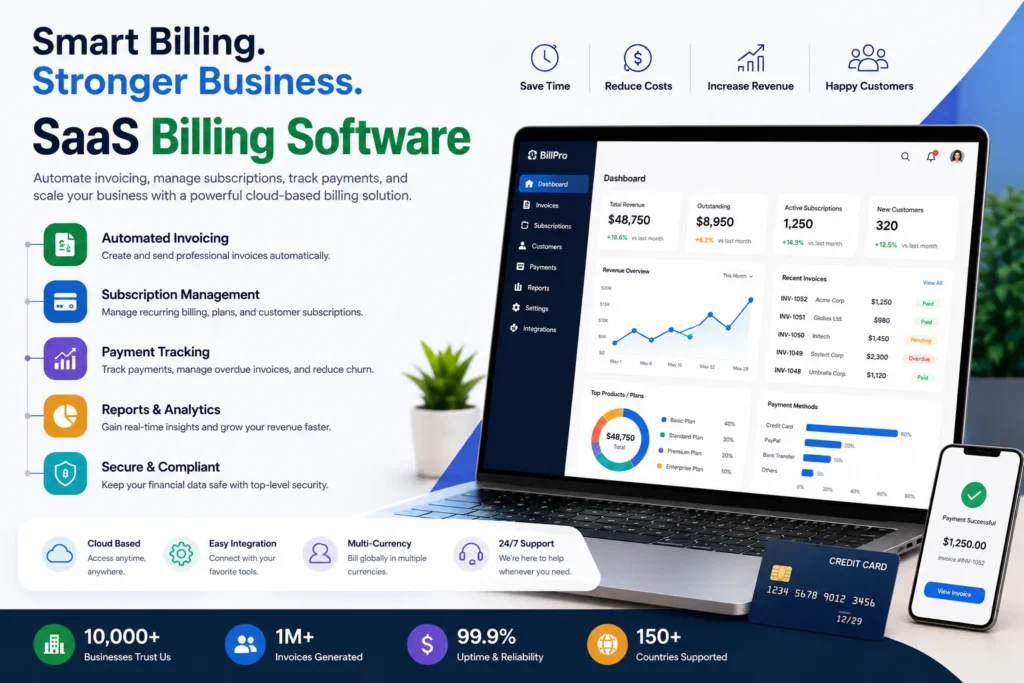
SaaS billing software is a cloud-based solution that automates billing, invoicing, subscription management, payment collection, and recurring payments for businesses. It helps companies reduce manual errors, improve cash flow, and manage customer subscriptions efficiently while integrating with accounting, CRM, and payment gateway systems.
What are the benefits of SaaS billing software?
The main benefits of SaaS billing software include automated recurring billing, accurate invoice generation, flexible subscription management, real-time financial reporting, secure payment processing, and reduced administrative workload. It also integrates with SaaS recruitment software, HR platforms, payroll systems, and accounting tools, helping businesses streamline operations and improve overall financial management.