
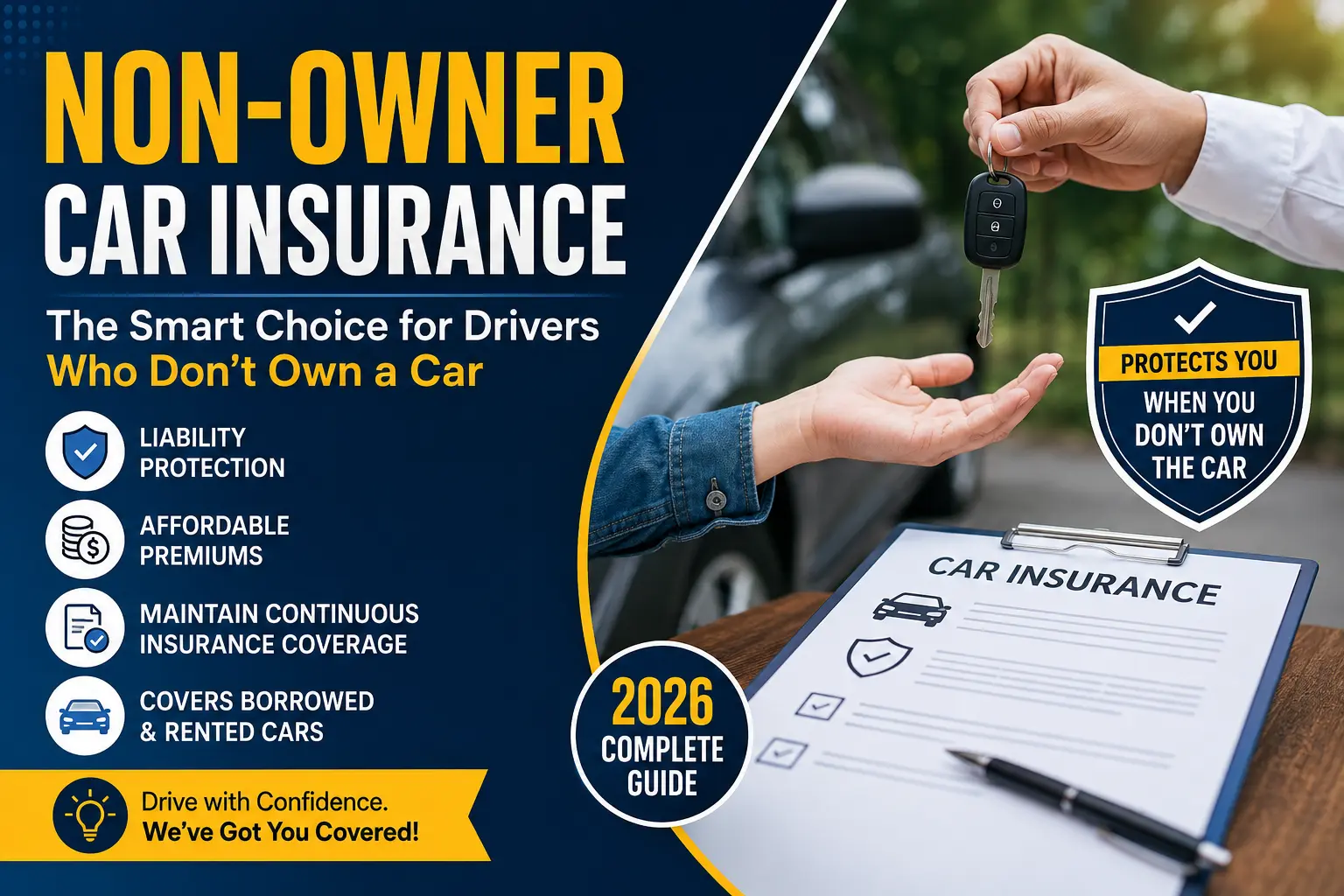
If you occasionally drive cars that you don’t own, you might wonder whether your friend’s insurance is enough to protect you. While many drivers assume the vehicle owner’s insurance always provides complete protection, that’s not always the case. This is where non-owner car insurance becomes valuable.
A non-owner policy is designed for people who drive borrowed or rented vehicles but do not own a car themselves. It provides liability coverage, helps maintain continuous insurance history, and may even reduce future premiums when you eventually purchase your own vehicle.Renters insurance
Many drivers also confuse temporary car insurance with non-owner coverage. Although they sound similar, they serve different purposes. Understanding these differences can help you choose the right policy and avoid paying for coverage you don’t actually need.Pinterest
This comprehensive guide explains everything you need to know about non-owner car insurance in 2026, including how it works, who should buy it, what it covers, and how it compares with temporary car insurance.Readmore
What Is Non-Owner Car Insurance?
Non-owner car insurance is a liability-only insurance policy designed for individuals who do not own a vehicle but occasionally drive cars belonging to someone else.
Instead of insuring a specific vehicle, the policy insures you as the driver.
This type of insurance usually acts as secondary liability coverage after the owner’s policy has been used.
For example, if you borrow your sibling’s car and accidentally cause an accident, the owner’s insurance generally pays first. If the damages exceed the owner’s liability limits, your non-owner policy may help cover the remaining liability, depending on your insurer and policy terms.
Unlike traditional auto insurance, a non-owner policy is not tied to one specific vehicle. Instead, it follows the insured person whenever they legally drive an eligible vehicle.
Key Features
- Liability coverage
- Covers occasional driving
- No vehicle ownership required
- Lower premiums than standard policies
- Helps maintain continuous insurance history
- Available in most U.S. states
- Suitable for drivers who frequently borrow cars
How Does Non-Owner Car Insurance Work?
Think of non-owner insurance as protection that follows the driver instead of the vehicle.
Whenever you borrow a car with permission, your policy provides liability protection if you’re responsible for an accident.
Here’s a simple example.
Sarah sold her car because she now works remotely. Occasionally, she borrows her sister’s vehicle for shopping or weekend trips.
Instead of buying a full auto insurance policy for a vehicle she doesn’t own, Sarah purchases a non-owner insurance policy.
If Sarah causes an accident:
- Her sister’s insurance pays first.
- Sarah’s non-owner policy may provide additional liability protection if damages exceed the owner’s limits.
- Sarah avoids paying large liability expenses out of pocket.
This makes non-owner insurance an affordable solution for occasional drivers.
Who Needs Non-Owner Car Insurance?
Not everyone needs this type of policy. However, several groups can benefit significantly.
1. People Who Frequently Borrow Cars
If you regularly drive vehicles owned by friends or family members, non-owner insurance provides an extra layer of financial protection.
Instead of relying entirely on someone else’s insurance, you have your own liability coverage.
2. Drivers Between Vehicles
Perhaps you’ve recently sold your car and plan to purchase another one later.
Rather than canceling your insurance completely, a non-owner policy helps maintain continuous insurance coverage.
Insurance companies often reward continuous coverage with lower premiums in the future.
3. Drivers Who Rent Cars Frequently
People who travel often for work or vacations may rent vehicles several times each year.
Although rental companies sell insurance at the counter, purchasing non-owner coverage may provide liability protection that applies whenever you rent eligible vehicles.
4. Drivers Required to File an SR-22
Many states require drivers convicted of serious traffic violations to maintain proof of financial responsibility.
If you don’t own a vehicle but must file an SR-22, a non-owner insurance policy can often satisfy this legal requirement.
5. Ride-Share Drivers Between Vehicles
Some ride-share drivers who temporarily don’t own a car may purchase non-owner coverage while arranging another vehicle.
6. College Students
Students attending universities away from home often borrow roommates’ or relatives’ vehicles occasionally.
Instead of purchasing a full insurance policy, non-owner insurance may provide affordable liability coverage.
7. Military Personnel
Military members stationed in different locations sometimes sell their vehicles but still drive borrowed cars during leave.
Non-owner insurance can provide affordable protection during this transition.
Who Does NOT Need Non-Owner Car Insurance?
Although useful, non-owner insurance isn’t suitable for everyone.
You probably don’t need it if:
- You own a vehicle.
- You drive the same household vehicle regularly.
- You’re already listed on another person’s insurance policy.
- You rarely drive.
- You only use public transportation.
- You never borrow vehicles.
Buying unnecessary insurance only increases your expenses.
What Does Non-Owner Car Insurance Cover?
Coverage varies by insurance company and state laws, but most policies include liability protection.
Bodily Injury Liability
Pays for injuries suffered by other people if you’re responsible for an accident.
It may help cover:
- Hospital bills
- Medical expenses
- Rehabilitation costs
- Lost wages
- Legal settlements
Property Damage Liability
This coverage helps pay for damage you cause to another person’s property.
Examples include:
- Another vehicle
- Mailboxes
- Fences
- Buildings
- Street signs
- Utility poles
Legal Defense Costs
If you’re sued following an accident, your insurer may provide legal defense within your policy limits.
Legal expenses can quickly become expensive, making this coverage valuable.
State Minimum Requirements
Most policies satisfy the minimum liability insurance requirements established by your state.
Always verify your state’s coverage limits before purchasing a policy.
What Isn’t Covered?
Understanding exclusions is just as important as knowing what’s covered.
Most non-owner insurance policies do not include:
Collision Coverage
Damage to the borrowed vehicle usually isn’t covered.
Comprehensive Coverage
The policy generally won’t pay for:
- Theft
- Fire
- Flood damage
- Hail damage
- Falling objects
- Animal collisions
Personal Vehicle Damage
Because you don’t own a vehicle under this policy, repairs to a personal car aren’t included.
Commercial Driving
Many insurers exclude:
- Delivery driving
- Commercial trucking
- Certain ride-share activities
- Business vehicle use
Always read your policy carefully.
Is Non-Owner Car Insurance the Same as Temporary Car Insurance?
No.
Many people use these terms interchangeably, but they describe different types of coverage.
| Feature | Non-Owner Car Insurance | Temporary Car Insurance |
|---|---|---|
| Covers the driver | ✅ | Usually vehicle-specific |
| Covers a specific car | ❌ | Usually yes |
| Best for frequent borrowing | ✅ | ❌ |
| Duration | Ongoing policy | Short-term |
| Liability coverage | Yes | Depends on insurer |
| Vehicle ownership required | No | Usually yes or temporary use |
Although both options provide flexibility, temporary car insurance is generally intended for short-term situations, while non-owner car insurance is designed for people who regularly drive vehicles they don’t own.
Why Is Non-Owner Car Insurance Becoming More Popular in 2026?
Several trends are driving demand for this type of coverage:
- More people work remotely.
- Car ownership costs continue to rise.
- Vehicle sharing is becoming more common.
- Ride-sharing services are expanding.
- Younger drivers are delaying car purchases.
- Consumers want affordable insurance options.
- Insurance companies now offer more flexible policies.
As transportation habits evolve, non-owner insurance has become a practical option for many drivers who don’t need a full traditional auto policy.
Benefits of Non-Owner Car Insurance
Buying non-owner car insurance offers more than just meeting legal requirements. It can provide financial security, protect your driving record, and even help you save money over time.
1. Maintain Continuous Insurance Coverage
One of the biggest advantages is maintaining continuous insurance coverage.
Insurance companies often view gaps in coverage as a higher risk. If you cancel your insurance after selling your car and go several months without coverage, your future premiums may increase when you buy another vehicle.
A non-owner policy helps avoid these gaps and can make you eligible for better rates later.
2. Financial Protection
Accidents can happen at any time, even when you’re driving someone else’s vehicle.
If you’re responsible for an accident, medical bills and property damage can quickly become expensive.
Without insurance, you may have to pay these costs yourself.
A non-owner policy provides liability protection that can reduce your financial risk.
3. Affordable Premiums
Since the policy doesn’t insure a specific vehicle, it usually costs much less than a standard auto insurance policy.
For many occasional drivers, this makes it one of the most affordable ways to stay insured.
4. Peace of Mind
Borrowing a friend’s or family member’s car becomes less stressful when you know you have liability protection.
Instead of worrying about unexpected expenses after an accident, you can drive with greater confidence.
5. Helpful for SR-22 Filings
Drivers who need an SR-22 certificate but don’t own a vehicle can often use a non-owner policy to meet state requirements.
This allows them to maintain legal driving privileges while they work toward restoring a clean driving record.
6. Flexible Coverage
Unlike traditional insurance tied to one vehicle, non-owner insurance follows you as the driver.
If you occasionally drive different vehicles with permission, one policy can provide coverage across eligible situations.
How Much Does Non-Owner Car Insurance Cost in 2026?
The cost of non-owner car insurance varies depending on several factors, including your location, driving history, age, and insurance company.
In 2026, most drivers can expect average annual premiums such as:
| Driver Profile | Estimated Annual Cost |
|---|---|
| Clean driving record | $250–$550 |
| Young driver | $400–$800 |
| Driver with traffic violations | $600–$1,000+ |
| SR-22 required | $700–$1,300+ |
These are general estimates. Your actual premium depends on your insurer, state regulations, and personal risk profile.
Although prices differ, non-owner policies are usually much cheaper than full-coverage auto insurance because they provide liability protection only.
Factors That Affect Your Premium
Insurance companies calculate premiums using multiple risk factors.
Driving History
Drivers with a clean record often qualify for lower rates.
Recent accidents, speeding tickets, or DUI convictions usually increase premiums.
Age
Young and inexperienced drivers typically pay more because they present a higher statistical risk.
Older drivers with safe driving histories often receive lower rates.
State Requirements
Every state has different minimum liability requirements.
States with higher mandatory coverage limits may have higher average premiums.
Credit-Based Insurance Score
In many states, insurers may consider a credit-based insurance score when calculating premiums.
Maintaining good financial habits can sometimes help reduce costs where this practice is permitted.
Annual Mileage
Although you don’t own a vehicle, insurers may ask how frequently you expect to drive borrowed or rented cars.
More frequent driving can influence your premium.
SR-22 Requirement
Drivers who need an SR-22 filing generally pay more because insurers consider them higher risk.
Who Offers Non-Owner Car Insurance?
Many major insurers provide non-owner policies, although availability varies by state.
Some well-known companies include:
- GEICO
- State Farm
- Progressive
- Travelers
- Nationwide
- USAA (for eligible military members and families)
- Farmers
- Auto-Owners Insurance
Before purchasing a policy, compare quotes from multiple insurers to find the best combination of price and coverage.
How to Compare Non-Owner Car Insurance Quotes
Choosing the cheapest policy isn’t always the best decision.
Consider these factors when comparing quotes.
Liability Limits
Higher liability limits provide better financial protection.
Although minimum coverage may satisfy legal requirements, increasing your limits can help protect your assets after a serious accident.
Company Reputation
Look for insurers with strong customer service, reliable claims handling, and good financial strength.
Independent customer reviews can also provide useful insights.
Discounts
Some insurers offer discounts for:
- Safe drivers
- Bundling policies
- Completing defensive driving courses
- Paying annually
- Maintaining continuous coverage
Always ask which discounts are available before purchasing a policy.
Financial Stability
Choose an insurance company with a strong financial reputation so you can feel confident that claims will be paid if needed.
How to Buy Non-Owner Car Insurance
Buying a policy is usually straightforward.
Step 1
Gather your driver’s license and personal information.
Step 2
Request quotes from several insurance companies.
Step 3
Compare:
- Liability limits
- Monthly premium
- Deductibles (if applicable)
- Customer reviews
- Available discounts
Step 4
Choose the policy that best fits your needs and budget.
Step 5
Complete your application and make the first payment.
Most insurers can issue proof of insurance electronically within minutes.
Common Mistakes to Avoid
Many drivers misunderstand how non-owner insurance works.
Avoid these common mistakes.
Assuming It Covers the Vehicle
A non-owner policy generally protects your liability, not damage to the borrowed vehicle.
Always understand what is and isn’t covered.
Buying Coverage You Don’t Need
If you’re already listed as a driver on someone else’s policy or you own a vehicle, a non-owner policy may not be appropriate.
Review your situation before purchasing.
Ignoring Liability Limits
Choosing only the minimum required coverage could leave you responsible for costs above your policy limits.
Consider whether higher limits are worth the added protection.
Forgetting to Compare Quotes
Premiums can vary significantly between insurers.
Getting multiple quotes can help you find better value.
Non-Owner Car Insurance vs Temporary Car Insurance
Many people compare non-owner car insurance with temporary car insurance, but understanding their differences can help you select the right option.
Non-Owner Car Insurance
- Designed for people who don’t own a vehicle.
- Usually provides ongoing liability coverage.
- Best for drivers who regularly borrow different cars.
- Helps maintain continuous insurance history.
Temporary Car Insurance
- Intended for short-term use in specific situations.
- Often associated with a particular vehicle or a defined coverage period.
- May be suitable when you need insurance for a limited time, depending on what’s available in your state or country.
- Not every insurer offers true short-term policies.
If you frequently drive vehicles you don’t own throughout the year, a non-owner policy is often the more practical solution.
Real-Life Example
Imagine Alex sold his car because he now works from home.
He borrows his parents’ vehicle a few times each month for grocery shopping and medical appointments.
Instead of paying for a traditional auto insurance policy, Alex purchases a non-owner car insurance policy.
A few months later, Alex accidentally rear-ends another vehicle while driving his parents’ car.
The vehicle owner’s insurance generally responds first according to the policy terms. If the damages exceed those limits and Alex’s policy applies, his non-owner liability coverage may provide additional protection.
Without that coverage, Alex could face significant out-of-pocket expenses.
Expert Tips Before Buying
- Compare quotes from at least three insurers.
- Choose liability limits that fit your financial situation.
- Ask about available discounts.
- Keep your coverage active to avoid insurance gaps.
- Read the policy exclusions carefully.
- Confirm whether an SR-22 filing is available if you need one.
- Review your policy annually as your driving habits change. other in Quora
Frequently Asked Questions (FAQ)
What is non-owner car insurance?
Non-owner car insurance is a liability-only auto insurance policy designed for people who don’t own a vehicle but occasionally drive borrowed or rented cars. It helps pay for bodily injury and property damage you cause to others if you’re at fault in an accident.
Who should buy non-owner car insurance?
This policy is ideal for people who:
Frequently borrow vehicles from friends or family.
Rent cars often.
Need continuous insurance coverage.
Are required to file an SR-22 but don’t own a car.
Are between vehicle purchases.
Does non-owner car insurance cover rental cars?
Most non-owner policies provide liability coverage while driving eligible rental cars, but they generally do not include collision or comprehensive coverage for damage to the rental vehicle. Always check the policy details with your insurer.
Does non-owner insurance cover the car I’m driving?
No. A non-owner policy usually covers your liability as the driver, not damage to the vehicle you’re borrowing. The vehicle owner’s policy is typically the primary insurance.
Is non-owner car insurance cheaper than regular insurance?
Yes. Because it doesn’t insure a specific vehicle and usually provides liability coverage only, non-owner car insurance is often significantly less expensive than a standard auto insurance policy.
Can I get an SR-22 with non-owner insurance?
In many states, yes. Many insurers offer non-owner SR-22 insurance for drivers who need proof of financial responsibility but do not own a vehicle.
Can I drive any car with non-owner insurance?
You can generally drive vehicles that you have permission to use and that meet your policy’s eligibility requirements. Policies may exclude vehicles available for your regular use or vehicles owned by members of your household.
Is temporary car insurance the same as non-owner insurance?
No. Temporary car insurance is generally intended for short-term situations, while non-owner car insurance provides ongoing liability coverage for drivers who regularly use vehicles they don’t own
Does non-owner insurance cover my spouse?
Typically, no. Coverage usually applies only to the named insured unless the policy specifically states otherwise.
How can I lower my non-owner insurance premium?
You may be able to reduce your premium by:
Maintaining a clean driving record.
Comparing quotes from multiple insurers.
Choosing an appropriate coverage limit.
Taking advantage of available discounts.
Avoiding lapses in insurance coverage.
Key Takeaways
If you don’t own a vehicle but drive occasionally, non-owner car insurance can be a practical and cost-effective solution. It provides liability protection, helps maintain continuous insurance coverage, and may reduce future premiums when you eventually purchase a car.
Although temporary car insurance may suit short-term situations, drivers who regularly borrow different vehicles often benefit more from a non-owner policy.
Before purchasing coverage, compare multiple quotes, review policy exclusions carefully, and choose liability limits that provide appropriate financial protection.
Final Verdict
Choosing the right insurance depends on how often you drive and whether you own a vehicle.
If you regularly borrow cars, rent vehicles, or need to maintain insurance coverage without owning a car, non-owner car insurance is often a smart choice. It offers affordable liability protection and helps you avoid coverage gaps that could lead to higher premiums in the future.
On the other hand, if you only need insurance for a very short period or a specific driving situation, temporary car insurance may be worth exploring where it’s available.
Understanding the differences between these two options allows you to make a more informed decision and select coverage that fits your driving habits and budget.